

7 Steps to Hang a Flag on Your House Exterior
Last Updated: November 2, 2026
Quick Summary
To hang a flag on your house, gather a drill with a masonry bit, a level, and anchors rated for your wall. Match the bracket to the pole's base diameter, mount it into solid masonry or framing, seal each hole, and check that the pole is plumb and clears the roof.
- Match the bracket to the pole's base: 2.4 inches for the 16 Ft Classic, 2.75 inches for the 20 Ft Superior 1.
- Drill into a sound mortar joint for brick, and use a mounting block to reach framing behind vinyl siding.
- Seal every bracket penetration with exterior-grade sealant to keep water out of the wall.
- Re-check the bracket screws after the first strong wind, since new anchors can settle.
- For RVs, check hitch-mount compatibility and actual roof clearance before installing.
Table of Contents
- What You Need Before You Start Hanging a Flag
- Choosing the Right Spot on Your Home
- What Size Flag for a House Works Best
- How to Mount a Flag on a Brick House
- House Flagpole Bracket Installation Step by Step
- How to Prevent a Flag From Wrapping Around the Pole
- Start Your Flag Display With the Right Pole and Bracket
- Frequently Asked Questions
What You Need Before You Start Hanging a Flag
Hanging a flag on your house takes less than an afternoon if you have the right gear ready. Most homeowners only need a few basic tools and a bracket that fits their wall before they hang a flag.
Gather these items before you begin:
- A power drill with a masonry bit (for brick or stone)
- A level, to keep the bracket straight
- A tape measure and a pencil
- Work gloves and safety glasses
- Masonry anchors and screws rated for your wall material
Pick the flagpole and bracket first. Check that the bracket matches the pole's base diameter. For example, the 16 Ft Classic uses a 2.4-inch base, while the 20 Ft Superior 1 uses a 2.75-inch base.
Compare the pole options on our Heavy Duty Telescoping Flagpoles page to see gauge, base size, and warranty side by side. We select the included flag, solar light, and flag hardware to match each pole, so you won't have to hunt for compatible parts.
Choosing the Right Spot on Your Home
Pick a spot where the flag is easy to see and the pole has room to swing. A front porch column or the wall beside the front door works well for most homes when you hang a flag.
Check these details before you mark anything:
- Look up at the eaves and gutters for clearance
- Make sure the pole won't hit windows, lights, or vents
- Confirm the wall is solid enough to hold the bracket
If you want a shorter pole for a lower roofline, the 16 Ft Classic Telescoping Flagpole Kit is a practical option for that spot.
What Size Flag for a House Works Best
Flag size should match the pole and the space around your home. A 3x5 flag suits most standard front-porch setups, while a larger display may suit a tall house with a wide front.
- 3x5 flag: Best for most single-story homes and tighter spaces
- 4x6 flag: Better for larger homes and taller poles
The 20 Ft Superior 1 Telescoping Flagpole Kit comes with a 3x5 flag. The 30 Ft Heavy Duty Superior 2 Telescoping Flagpole Kit includes a 4x6 flag for a bigger display.
How to Mount a Flag on a Brick House
The fastener choice changes with the wall, so the steps below include small adjustments for each surface.
Before you drill, confirm what is behind the surface. Brick veneer sits over wood framing or sheathing, and a bracket that only grabs the veneer can work loose. A masonry anchor that reaches the structural backup is the safer choice for a loaded pole.
Brick, Block, and Stone Veneer
Use a carbide-tipped masonry bit sized to your anchor. Drill into the mortar joint when the joint is in good condition and at least as wide as the anchor. Skip cracked or crumbling mortar and move to a solid brick face instead.
- Mark the bracket position with a pencil and check it with a level.
- Drill a pilot hole into the mortar joint or brick face.
- Clear the dust with a brush or a short burst of air.
- Insert the masonry anchor and tap it flush.
- Drive the screw until the bracket is snug, not crushed.
A common pattern is to use a sleeve anchor or a lag shield in solid brick and a screw anchor in block. Match the anchor to the pole's base diameter and the bracket's hole pattern.
Vinyl Siding
Vinyl siding is a rain screen, not a structural surface. Do not tighten a bracket against the vinyl alone. Instead, locate the framing behind the siding and use a mounting block or a bracket standoff to bridge the siding.
- Find the studs with a stud finder and confirm with a small finish nail.
- Mark the stud centers above and below the bracket location.
- Seal the penetration with exterior-grade sealant after the screws are set.
- Leave the siding room to move; do not pin it tight against the bracket.
A standoff keeps the pole base clear of the siding and reduces the chance of water tracking behind the panel.
Stucco and Fiber Cement
Stucco and fiber cement are hard, brittle surfaces that crack under point loads. Use a masonry bit and an anchor designed for the material, and avoid over-tightening.
- Drill slowly and let the bit do the work.
- Use a washer under each screw head to spread the load.
- Seal every hole with exterior sealant.
- Check for wiring and pipes before drilling; a stud finder with a live-wire alert helps.
Fiber cement behaves more like masonry than wood. Treat it as a brittle surface and plan for anchors, not wood screws.
20 Ft Superior 1 Telescoping Flagpole Kit →
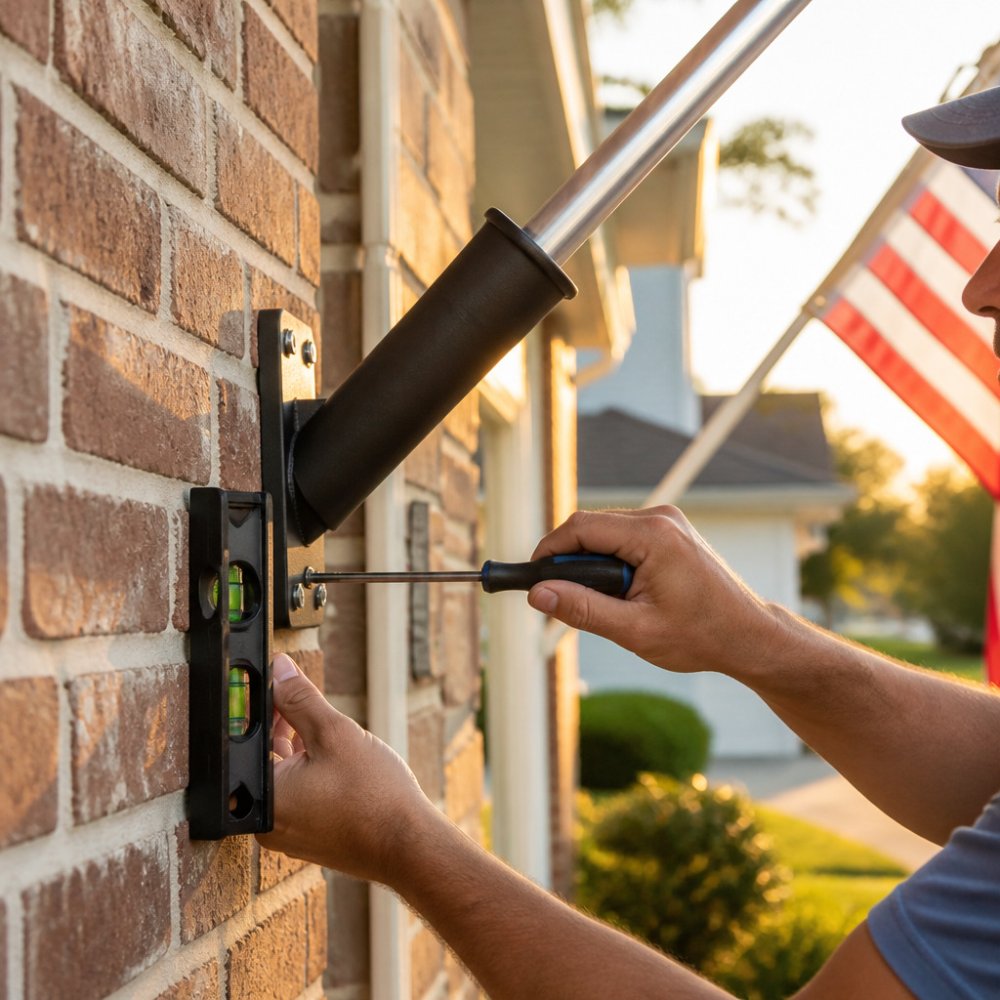
The right fastener depends on the wall surface, so this table matches each material to its anchor approach.
| Wall surface | Fastener approach | Key note |
|---|---|---|
| Brick, block, stone veneer | Masonry anchor in solid brick or block | Drill into a sound mortar joint |
| Vinyl siding | Mounting block or standoff to framing | Do not tighten against vinyl alone |
| Stucco, fiber cement | Masonry anchor with washer | Drill slowly and seal each hole |
House Flagpole Bracket Installation Step by Step
A bracket install is simple, but the details decide whether the pole stays plumb through a windy season. Work through these steps in order and check each one before moving on.
Match the Bracket, Fasteners, and Pole
Start with the pole's base diameter. The 16 Ft Classic uses a 2.4-inch base, and the 20 Ft Superior 1 uses a 2.75-inch base. A bracket that does not match the base will let the pole rock.
Choose fasteners rated for the wall material and the load. A longer pole and a larger flag put more leverage on the bracket, so use the anchor type the bracket maker specifies for that surface. When in doubt, go up one anchor size rather than down.
Mark, Drill, and Seal
- Hold the bracket against the wall and check it with a level in both directions.
- Mark the screw holes with a pencil.
- Drill pilot holes sized to the anchors.
- Clear the dust and insert the anchors.
- Fasten the bracket and re-check the level.
- Seal each penetration with exterior-grade sealant.
Sealing matters on every surface. Water that gets behind a bracket can rot framing or stain siding, and the sealant is cheap insurance.
Set the Pole and Check Drainage
The pole has an adjustment screw, a bottom stop bolt, and an open bottom for drainage. Slide the pole into the bracket, set the adjustment screw, and confirm the bottom stop bolt is in place. Keep the bottom open so water can drain out.
Check that the pole sits straight and that the flag clears the roof, gutters, and any nearby trees. A quick sight down the pole from the ground catches most lean.
RV and Camper Mounting Notes
For RVs and trailers, check hitch-mount compatibility with the pole's base diameter and confirm actual roof clearance first. Lower campers typically use the 16-foot pole, while taller RVs and fifth wheels need the 20-foot Superior 1 for flag clearance.
Never mount a bracket to a ladder rack, RV ladder, or ladder-mounted clamp. These setups can tear up and damage the equipment and the vehicle.
How to Prevent a Flag From Wrapping Around the Pole
Flags wrap when wind is light and the pole is not well balanced. Attach the flag snugly and check it often.
- Use the included flag hardware for a secure fit
- Keep the pole straight and plumb
- Take the flag down in heavy wind
Start Your Flag Display With the Right Pole and Bracket
Choose the pole, bracket, and flag size that fit your home, then follow the steps above for a secure install. Contact Armor Flagpoles with questions about sales or installation.
Frequently Asked Questions
How do I hang a flag from my house?
Choose a spot on the porch or exterior wall with room for the flag to fly clear of railings and windows. Mount a bracket at roughly a 45-degree angle, drill pilot holes into solid framing or masonry, and secure the bracket with the correct anchors. Slide the pole into the bracket, then attach the flag. Check that the bracket is tight and the pole sits level before you leave the area.
What size flag do you hang outside your house?
Flag size should match the scale of your home and the length of your pole. A common choice for a single-story home is a 3-by-5-foot flag on a pole around 15 to 20 feet tall. Larger homes or wider porches may suit a bigger flag. Consider how much wind your area sees, since larger flags catch more wind and put more load on the bracket and fasteners.
How to mount a flag on a brick house?
Brick needs masonry anchors rather than wood screws. Mark the bracket position on a mortar joint, not the brick face, when possible, because mortar is easier to drill. Use a masonry bit, drill pilot holes to the depth your anchors require, clean out the dust, and set the anchors. Then fasten the bracket and confirm it is solid before adding the pole.
How do I keep a house flag from wrapping around its pole?
Wrapping usually happens on windy days when the flag cannot fly freely. Use a properly sized flag for your pole, keep the bracket angle consistent, and make sure the flag's grommets and attachment points are not twisted. Some homeowners add a swivel or check the fit regularly so the flag can rotate and unfurl instead of tangling.
Frequently Asked Questions
What size flag should I hang on my house? A 3x5 flag suits most single-story homes. A 4x6 flag works better for taller homes with a wide front.
Can I mount a flagpole on brick? Yes. Drill into the mortar joint with a masonry bit and use masonry anchors rated for your wall.
How do I keep a flag from wrapping? Keep the pole straight, attach the flag securely, and take it down in heavy wind.
