

Best Residential Flagpoles for Wind: 2026 Guide
Table of Contents
- Why Most Residential Flagpoles Fail in High Wind
- Wind Speed Rating for Flagpoles: What the Numbers Actually Mean
- Telescoping vs. Sectional Flagpoles for Wind: Which Design Holds Up
- Residential Flagpole Foundation Requirements for High-Wind Areas
- Material and Hardware: What Separates the Best Residential Flagpoles for Wind
- Coastal and Hurricane Zone Installation: What Changes
- DIY vs. Professional Installation and Post-Storm Inspections
- Frequently Asked Questions
Last Updated: September 20, 2026
Why Most Residential Flagpoles Fail in High Wind
Most residential flagpoles fail in high wind because the pole was undersized for the load, not because the wind was unusually strong. A flag whipping in a gust transfers force through the halyard and hardware, and if the wall thickness, butt diameter, or foundation can't absorb it, something bends, cracks, or pulls loose.
Wind Speed Rating for Flagpoles: What the Numbers Actually Mean
A wind speed rating for flagpoles tells you the maximum sustained wind a pole can handle while flying a flag of a specified size. Change the flag size and the real rating changes too, because a larger flag catches more wind and multiplies the load, which is why two poles of identical height can carry wildly different ratings.
How Wind Load and Gust Tolerance Are Calculated
Wind load is the force wind exerts on the flag and pole surface. It rises with the square of wind velocity, so a gust at double the speed roughly quadruples the load, which is why a 40 mph day feels manageable and a 70 mph day snaps hardware: the load isn't 1.75x higher, it's closer to 3x.
- Projected area, a 3x5 flag presents roughly 15 square feet of sail; a 4x6 presents roughly 24. That's a 60% jump in load for the same wind, on the same pole.
- Velocity squared, going from 60 mph to 90 mph more than doubles the force.
- Drag coefficient, a flag that streams straight out sheds load; a flag that flutters and snaps edge-on loads the pole in pulses that fatigue metal faster than steady pressure.
How to Derive the Rating You Actually Need
Start with the design wind speed for your location. The American Society of Civil Engineers publishes ASCE 7, the standard building codes reference for wind loads, and its wind hazard maps break the country into zones with basic wind speeds from about 90 mph inland to 130 mph or higher along hurricane-exposed coastlines. Your local building department can tell you which figure applies to your address.
Hurricane-Rated vs. Standard Residential Poles
Hurricane rated poles use thicker walls, larger butt diameters, and heavier hardware than standard residential models. That isn't marketing language, it's the structural margin that lets the pole flex without taking a permanent bend. Where gusts regularly top 60 mph, a standard pole is the wrong tool.
| Pole Type | Typical Best For | Wind Margin | Hardware |
|---|---|---|---|
| Standard residential | Sheltered inland yards | Moderate | Light-duty |
| Heavy-duty residential | Open lots, gusty regions | High | Reinforced |
| Hurricane rated | Coastal and storm zones | Highest | Tanker-tough grade |
Telescoping vs. Sectional Flagpoles for Wind: Which Design Holds Up
Telescoping flagpoles generally hold up better in wind than sectional poles because they have fewer external joints and a continuous internal overlap. Each joint on a sectional pole is a stress point, and in high wind, stress points are where failures start.
Residential Flagpole Foundation Requirements for High-Wind Areas
Residential flagpole foundation requirements for high-wind areas come down to three numbers: hole depth, hole diameter, and concrete volume. A pole is only as strong as the ground holding it, and in high wind, the foundation takes the bending force that would otherwise snap the base.
Soil Composition and Concrete Footing Depth
Soil composition changes everything. Sandy or loose soil drains fast but grips poorly, so it needs a wider footing to spread the load. Clay holds moisture and can shift as it swells and shrinks, which slowly loosens the pole. Rocky or compacted soil offers the best grip and often needs the least concrete.
Material and Hardware: What Separates the Best Residential Flagpoles for Wind
Material grade and hardware quality separate a pole that lasts from one that fails. The best residential flagpoles for wind use high-strength aluminum, thick walls, and reinforced fittings that resist fatigue across thousands of gust cycles.
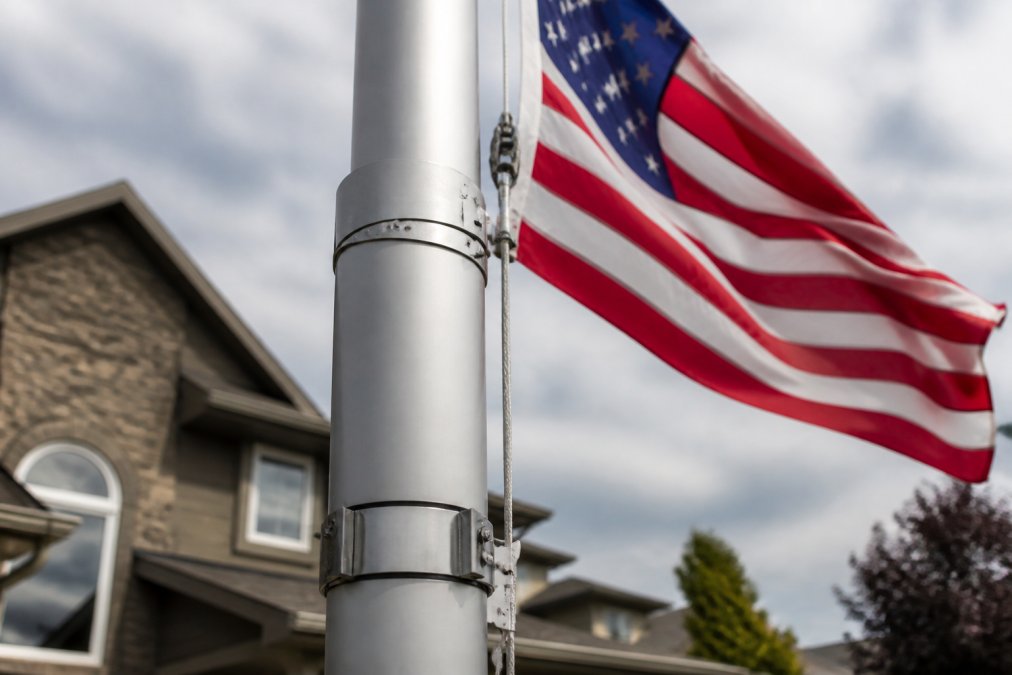
7000 T8 Aluminum vs. Fiberglass and Standard Aluminum
7000 T8 aluminum offers the highest tensile strength of the common flagpole materials, the pulling force a material resists before it yields. Higher tensile yield means the pole flexes in a gust and springs back instead of bending.
Flag Size Ratio, Swivel Harnesses, and Wind Load
Flag size ratio matters as much as the pole itself. A flag too large for the pole catches more wind load and overloads the hardware; matching flag size to pole height keeps load within the rating.
| Component | What It Does | Why It Matters in Wind |
|---|---|---|
| Swivel harness | Lets flag rotate freely | Cuts twist and halyard wear |
| Wall thickness | Resists bending force | Prevents permanent bend |
| Butt diameter | Anchors load at base | Improves stability |
| Corrosion resistance | Fights rust and salt | Extends pole life |
Coastal and Hurricane Zone Installation: What Changes
Coastal and hurricane zone installations demand more of every component: more corrosion resistance, more foundation depth, and more wind margin. Salt spray attacks unprotected metal, and hurricane-zone gusts expose any weak point.
DIY vs. Professional Installation and Post-Storm Inspections
DIY installation works for many homeowners, but it carries real risk in high-wind areas. Raising the pole is straightforward; the foundation is where DIY goes wrong, because an undersized footing won't show its weakness until the first big gust. Here's a decision framework plus a ten-minute post-storm inspection protocol.
A DIY Risk Assessment for High-Wind Zones
Before you dig, score yourself against these five factors. Any single "high" answer is a signal to call a professional.
| Factor | Low Risk | High Risk |
|---|---|---|
| Soil | Compacted loam or clay-loam | Loose sand, fill dirt, or expansive clay |
| Footing depth | Under 3 ft, above frost line | Over 4 ft or below frost line |
| Utilities | Verified clear by 811 call | Unknown or near marked lines |
| Pole height | 20 ft or less | Over 20 ft, or any sectional pole |
| Site | Sheltered inland yard | Open lot, waterfront, or ridge top |
Soil Composition and Concrete Footing Depth
Soil composition changes everything. Sandy or loose soil drains fast but grips poorly, so it needs a wider footing to spread the load. Clay holds moisture and can shift as it swells and shrinks, which slowly loosens the pole. Rocky or compacted soil offers the best grip and often needs the least concrete.
Match footing depth and width to your soil type, not just to the pole height. Loose or shifting soil needs a wider, deeper pour to hold the same pole.
Post-Storm Inspection Checklist
After any major storm, inspect before you fly the flag again. Walk the pole from the ground up, in this order:
- Footing, look for cracks radiating from the base, a gap between soil and concrete, or the pole leaning off plumb. Any of these means the footing moved.
- Base and butt, check for a bend or crease in the first three feet above the ground sleeve. This is where bending stress concentrates.
- Sections and joints, on a sectional pole, look for separation or elongation at each joint. On a telescoping pole, check that each section still seats fully.
- Locking collars, twist each collar by hand. A collar that spins freely or won't tighten has lost its grip and will slip under load.
- Halyard and swivel, run the halyard full travel. Fraying, flat spots, or a swivel that no longer rotates freely means replacement before the next wind event.
- Hardware and finish, look for rust streaks, pitting, or seized bolts. Salt-exposed poles show this first at the truck and cleat.
- Flag, inspect the fly end for tears and the grommets for elongation. A torn flag flogs harder and loads the pole more than an intact one.
When to Call a Pro
Professional installation makes sense when you're pouring a deep footing, working near utilities, or installing on a waterfront with complex soil. The labor cost buys a footing sized correctly for your wind zone, plus a permit trail if required. For a 20-foot telescoping pole in good soil, DIY is reasonable; for anything taller, sectional, or on sand or fill, the math favors hiring out.
Frequently Asked Questions
What wind speed rating should a residential flagpole have?
For most homes, look for a pole rated to at least 70-80 mph sustained winds. Coastal and hurricane-prone areas need poles rated higher, often 100 mph or more, depending on local building codes. The rating should reflect the pole's full assembly, including the ground sleeve and hardware, not just the tube. A 7000 T8 aluminum pole with 10-gauge wall thickness handles higher wind velocity than thinner standard poles of the same height.
Are telescoping flagpoles durable enough for hurricane-prone areas?
Yes, when they are built from high-strength aluminum and properly anchored. Telescoping poles have fewer joints exposed to wind than sectional poles, which reduces weak points. The critical factors are wall thickness, butt diameter, and the concrete footing. A telescoping pole with 10-gauge walls, an anodized finish for corrosion resistance, and a footing sized to local soil conditions can stay up through hurricane-force gusts. Always check the manufacturer's wind rating before buying.
Do I need a concrete foundation for a high-wind residential flagpole?
Yes. In high-wind areas, a concrete footing is required for structural integrity. A ground sleeve set in concrete keeps the pole plumb and transfers wind load into the soil. Depth depends on pole height, soil type, and local frost lines, but most residential installations call for a footing at least 24-36 inches deep. Sandy or loose soil needs a wider footing. Skipping concrete or using a shallow spike mount is the most common reason flagpoles lean or snap in storms.
How does 7000 T8 aluminum compare to standard flagpole materials?
7000 T8 aluminum has a higher tensile yield than the 6000-series aluminum used in most economy poles, so it resists bending under wind load without adding bulk. Combined with a 10-gauge wall thickness, it holds shape through repeated gusts. Fiberglass resists salt corrosion but can crack and splinter under impact. For coastal and high-wind residential use, 7000 T8 aluminum offers the best balance of strength, weight, and corrosion resistance, especially with an anodized finish.
High wind exposes every shortcut in a flagpole, from the wall thickness to the concrete under the base. Armor Flagpoles offers telescoping poles from 7000 T8 aluminum with 10-gauge thickness and tanker-tough hardware, made in the USA and covered by a 15-year factory warranty. If you want a pole engineered for real weather instead of fair-weather display, get started with Armor Flagpoles and choose a flagpole built to hold its ground.