

Durable RV Flagpole Mounting System: What to Know
Table of Contents
- What Makes a Durable RV Flagpole Mounting System
- RV Hitch Flagpole Mount: Why the Hitch Beats Other Options
- RV Flagpole Mount Compatibility: Matching Pole Base to Mount
- 16-Foot RV Flagpole: The Right Fit for Lower Campers
- RV Flagpole Roof Clearance: Measure Before You Mount
- Features to Look for in a Durable RV Flagpole Mounting System
- Common Mounting Mistakes to Avoid
- Conclusion
- Frequently Asked Questions
Last Updated: October 19, 2026
What Makes a Durable RV Flagpole Mounting System
A durable RV flagpole mounting system is a receiver-based setup that holds a telescoping pole steady while you travel, camp, and set up. At Armor Flagpoles, we build poles for owners who are tired of replacing flimsy gear every few seasons.
The mount matters as much as the pole. A loose connection rattles, wears the base, and lets the flag whip in gusty conditions. A solid one keeps the pole vertical and the load off your rig's body.
Below, we'll show you exactly what separates a mount that lasts from one that fails by year two. We'll also cover base diameters, roof clearance, and the mistakes that damage campers.
RV Hitch Flagpole Mount: Why the Hitch Beats Other Options
An RV hitch flagpole mount wins because the hitch is engineered to carry load. It is a steel receiver bolted to the frame, rated for towing forces far beyond a flag's weight.
Other options put stress where it doesn't belong. Bumper mounts flex thin metal. Suction cups let go in heat. Body-panel brackets drill holes that invite water intrusion.
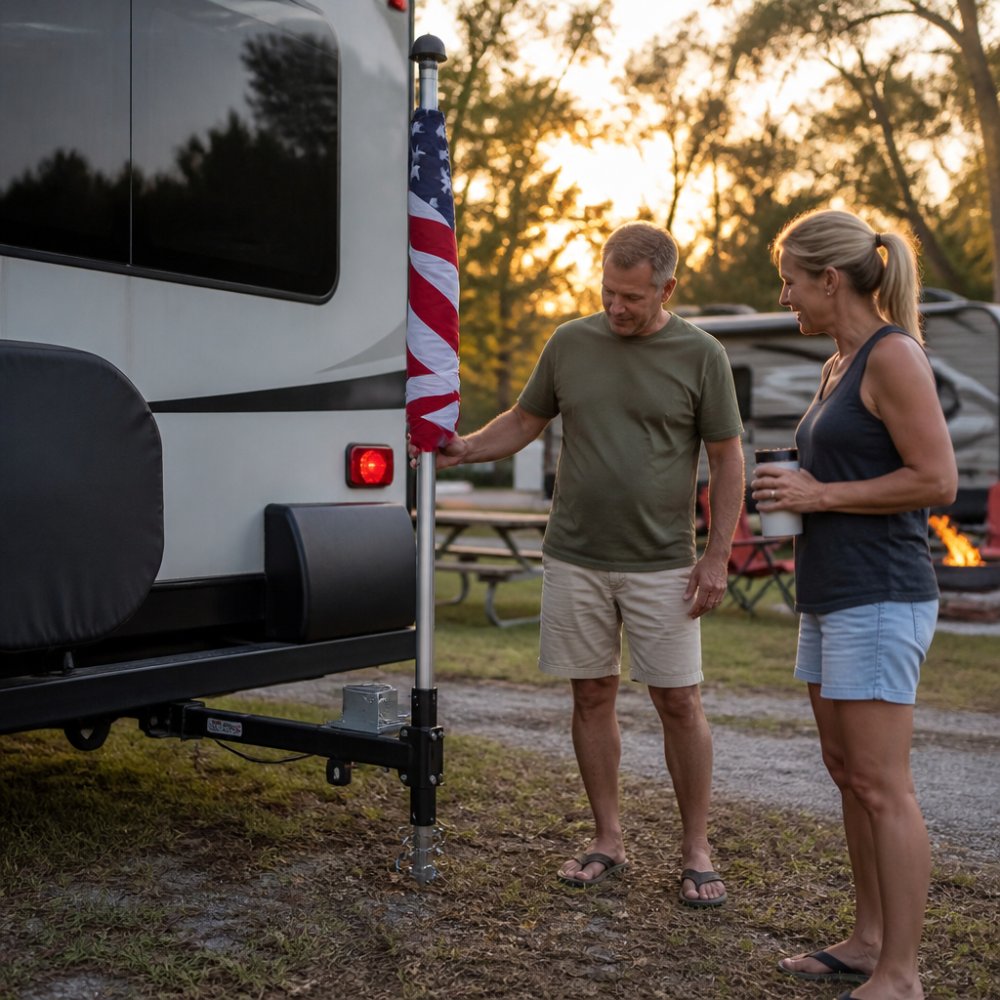
Adjustment Screw, Bottom Stop Bolt, and Open Bottom Drainage
Three small features do most of the durability work.
The adjustment screw tightens the pole inside the receiver. It removes play, so the pole stops rocking against the mount on windy days.
The bottom stop bolt sets how deep the pole sits. It also keeps the base from resting on the receiver floor, where grit collects.
The open bottom lets water drain out. Rain and road spray pass through instead of pooling inside the tube, which is where rust starts.
RV Flagpole Mount Compatibility: Matching Pole Base to Mount
RV flagpole mount compatibility comes down to one measurement: the pole's base diameter. If the base doesn't match the receiver, no amount of tightening fixes it.
Our two telescoping models use different bases:
| Pole Model | Base Diameter | Typical Setup |
|---|---|---|
| 16 Ft Classic | 2.4 inches | Lower campers, travel trailers |
| 20 Ft Superior 1 | 2.75 inches | Taller RVs, fifth wheels |
Measure your receiver's inner opening before ordering. A 2.75-inch base will not seat in a 2.4-inch receiver, and a loose 2.4-inch base in a wide receiver needs a shim or a different mount.
16-Foot RV Flagpole: The Right Fit for Lower Campers
The 16-foot RV flagpole suits lower campers because height creates use. Every extra foot of pole amplifies sway at the top, and a low roof leaves little room to spare.
On a standard travel trailer, a 16-foot pole clears the roofline with the flag flying above it. That gives you visible display without the pole crowding your air conditioner or vents.
Taller RVs and fifth wheels usually need the 20-foot Superior 1. The extra height lifts the flag above a taller roof, so it doesn't drag or snag.
20 Ft Superior 1 Telescoping Flagpole Kit →
RV Flagpole Roof Clearance: Measure Before You Mount
RV flagpole roof clearance is the step most owners skip, and it causes the most damage. A pole that looks fine in the driveway can contact the roof once the rig settles on its suspension.
Measure from the receiver opening to the highest point of your roof. Add the flag's height when furled. Leave a margin for suspension travel and uneven campsites.
Features to Look for in a Durable RV Flagpole Mounting System
A durable RV flagpole mounting system shares a few traits. Look for these before you buy:
- Frame-mounted receiver: Bolts to structural steel, not sheet metal or plastic trim.
- Adjustment screw: Removes play between pole and receiver.
- Bottom stop bolt: Sets depth and protects the base.
- Open bottom: Drains water so the tube doesn't hold moisture.
- Matched base diameter: Fits your specific pole, not a one-size-fits-all sleeve.
- Corrosion-resistant hardware: Handles road salt, coastal air, and rain.
At Armor Flagpoles, we match the included flag, solar light, and flag hardware to each pole. That takes the guesswork out of finding compatible components. Mounts and adapters are purchased separately unless a listing says otherwise.
Common Mounting Mistakes to Avoid
The biggest mistake is forcing a mismatched base into a receiver. It feels tight at first, then works loose and wears both parts.
A common mistake is skipping the drainage check. If the open bottom sits against a solid surface, water has nowhere to go.
Owners also overload the pole with oversized flags. A flag rated beyond the pole's recommendation adds strain at the top, where use is highest.
Finally, never mount to a ladder rack or ladder clamp. We have seen ladder racks torn up and campers damaged from that approach. Stick with a hitch receiver that matches your pole's base diameter.
Conclusion
Getting the mount right protects both your flag and your rig. Match the base diameter, check roof clearance, and confirm the drainage path before you head out.
Our 16 Ft Classic uses a 2.4-inch base, and the 20 Ft Superior 1 uses 2.75 inches. Measure your receiver, then check the current product listing for full specifications. When you're ready, browse our telescoping flagpoles and pick the setup that fits your camper.
Frequently Asked Questions
What is the best way to mount a flagpole on an RV?
A hitch-mounted receiver is the most reliable option for a durable RV flagpole mounting system. It keeps the pole off the roof and away from the ladder, and it spreads force into the vehicle's frame rather than thin body panels. Check that the mount's inner diameter matches your pole's base: 2.4 inches for the 16 Ft Classic and 2.75 inches for the 20 Ft Superior 1. Confirm your hitch receiver size and actual roof clearance before ordering.
Should I use a 16-foot or 20-foot flagpole on an RV?
Lower campers typically use the 16-foot pole, while taller RVs and fifth wheels need the 20-foot Superior 1 for flag clearance. The taller pole keeps the flag above the roofline so it does not snag or wrap on vents and AC units. Measure from the mount to the highest point on the roof, then add room for the flag to fly free. Always check actual roof clearance on your specific rig before you buy.
How do I choose an RV flagpole mount that fits my pole?
Start with the pole's base diameter. The 16 Ft Classic measures 2.4 inches at the base, and the 20 Ft Superior 1 measures 2.75 inches. Match that number to the mount's inner diameter, not the hitch receiver size alone. Look for an adjustment screw to take up slack, a bottom stop bolt to set pole height, and an open bottom so water drains out. A mount that fits loosely will rattle and wear.
How much roof clearance should I allow for an RV flagpole?
Allow enough clearance for the flag to fly without touching the roof, vents, or AC unit. Measure from the top of the mount to the highest roof point, then add the flag's height plus a margin for wind sway. Taller RVs and fifth wheels often need the 20-foot pole to clear the roofline. Never guess: check actual roof clearance on your rig with the pole extended before you travel.