

Heavy Duty Flagpole Reviews 2026: Top Picks & Guide
Table of Contents
- Quick Comparison: Heavy Duty Flagpole Reviews 2026
- How We Evaluated These Heavy Duty Flagpoles
- 1. 25 Ft Heavy Duty Superior 2 Telescoping Flagpole Kit
- 2. 20 Ft Heavy Duty Superior 2 Telescoping Flagpole Kit
- 3. 20 Ft Superior 1 Telescoping Flagpole Kit
- 4. 20 Ft Superior 2 Nautical Telescoping Flagpole Kit
- 5. 25 Ft Superior 2 Nautical Telescoping Flagpole Kit
- Hurricane Rated Flagpole: Wind Speed Rating for Flagpoles Explained
- Frequently Asked Questions
Last Updated: September 20, 2026
Quick Comparison: Heavy Duty Flagpole Reviews 2026
Shopping for a heavy duty flagpole in 2026 means cutting through vague marketing claims and looking at real specifications. This guide from Armor Flagpoles reviews five telescoping flagpoles built from 7000-T8 aluminum with 10-gauge wall thickness, all made in the USA and backed by a 15-year pole warranty. Every pick below is engineered for high-wind and coastal conditions, so you can match a pole to your property instead of guessing.

A heavy duty flagpole is a telescoping or sectional mast built from thick-walled aluminum and rated to hold a flag steady in sustained wind without bending, sticking, or corroding. The five Armor Flagpoles kits in this review range from $855 to $1,550 and share the same core engineering: five telescoping sections, stainless-steel hardware, and a ball-bearing swivel ring system that helps prevent flags from tangling.
| Model | Height | Base Diameter | Price | Best For |
|---|---|---|---|---|
| Heavy Duty Superior 2 | 25 ft | 3½ in | $1,200.00 | Large yards, maximum height |
| Heavy Duty Superior 2 | 20 ft | 3½ in | $1,150.00 | High-wind residential lots |
| Superior 1 | 20 ft | 2¾ in | $855.00 | Best value, standard yards |
| Superior 2 Nautical | 20 ft | 3½ in | $1,500.00 | Docks and waterfront homes |
| Superior 2 Nautical | 25 ft | 3½ in | $1,550.00 | Marinas, large coastal spaces |
Below, we break down each kit, explain what aluminum gauge and wind rating actually mean, and show you how to install a telescoping pole so it survives its first storm season.
How We Evaluated These Heavy Duty Flagpoles
We scored each heavy duty flagpole on five criteria that decide whether a pole lasts five years or twenty: aluminum gauge and alloy, base diameter, wind rating, hardware quality, and repairability. Every model here uses 7000-T8 aluminum, a high-strength alloy that resists bending better than the softer 6000-series aluminum common in budget poles. Wall thickness is 10 gauge across the lineup, which is the spec that separates a pole that whips in a gust from one that holds its shape.

We also weighed what ships in the box. A flagpole kit that includes a ground sleeve, stainless-steel swivel clips, and a solar light saves you a second shopping trip and, more importantly, ensures the mounting hardware matches the pole's wind load. Finally, we looked at long-term serviceability. Locking mechanisms and halyards wear out before the mast does, so a pole with replaceable parts and a real warranty is worth more than a cheaper one you throw away.
1. 25 Ft Heavy Duty Superior 2 Telescoping Flagpole Kit
The flagship pick for buyers who want maximum height and a base that anchors it. At $1,200.00, this 25-foot heavy duty flagpole pairs a 3½-inch base diameter with five telescoping sections, giving you a tall display that still lowers in minutes when weather turns.
What most guides miss is that base diameter, not height, drives stability. A 3½-inch base spreads wind load across more surface area at the ground, which is why this pole handles exposed lots better than slimmer 25-foot masts.
The kit ships complete: a 4x6 U.S. 210D nylon flag, a 566-LED solar light with charging adapter, a custom ground sleeve, four stainless-steel flag clips for flying two flags, a galvanized steel flash collar, and a ball topper. The ball-bearing swivel ring system lets the flag rotate with the wind instead of wrapping the halyard.
Pros: Tallest option with the large 3½-inch base; includes solar lighting and two-flag hardware; 15-year pole warranty. Cons: Overkill for a sheltered suburban yard; the heaviest kit to handle during installation. An eagle topper is not included.
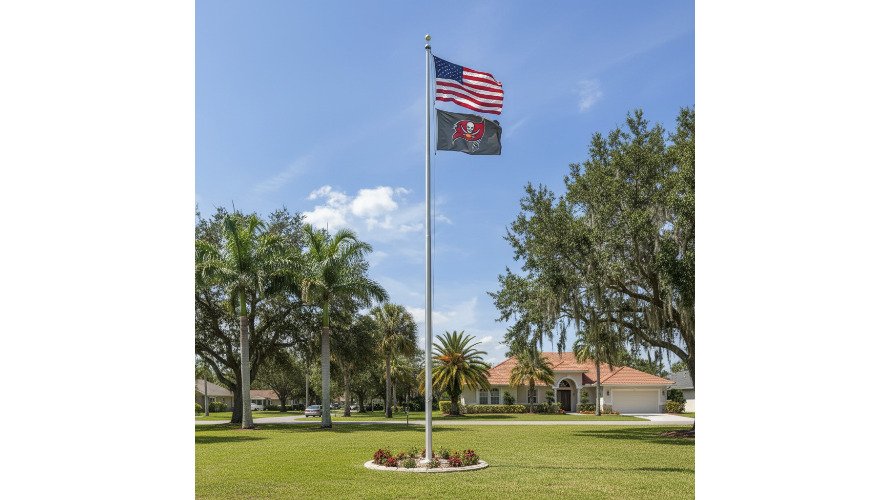
2. 20 Ft Heavy Duty Superior 2 Telescoping Flagpole Kit
For high-wind residential lots, the 20-foot version at $1,150.00 is the smarter buy. It carries the same 10-gauge 7000-T8 aluminum and 3½-inch base as its taller sibling, but the shorter mast reduces the lever arm that wind pushes against, which lowers the dynamic wind pressure on the foundation.

In practice, this means a 20-foot pole with a wide base often outperforms a 25-foot pole with a narrow one in gusty conditions. The kit includes the same 4x6 U.S. nylon flag, 566-LED solar light, ground sleeve, four stainless-steel clips, swivel ring system, and flash collar, all covered by the 15-year pole warranty.
Pros: Best balance of height and wind resistance; same heavy hardware as the 25-foot model; easier one-person installation. Cons: Shorter flag display than the 25-foot kit; still requires a proper concrete foundation.
3. 20 Ft Superior 1 Telescoping Flagpole Kit
Budget-conscious buyers should start here. At $855.00, the Superior 1 is the lowest-priced heavy duty flagpole in this review, and it keeps the 10-gauge 7000-T8 aluminum wall that matters most. The trade-off is a 2¾-inch base diameter instead of 3½ inches.
25 Ft Heavy Duty Superior 2 Telescoping →
That narrower base is fine for standard residential yards with some windbreak from trees or buildings. On an open coastal lot, step up to a Superior 2.
4. 20 Ft Superior 2 Nautical Telescoping Flagpole Kit
Coastal and waterfront properties need hardware that shrugs off salt spray, and this $1,500.00 nautical kit is built for exactly that. The 7000-T8 aluminum mast resists the oxidation that eats cheaper poles, and every attachment is stainless steel.
5. 25 Ft Superior 2 Nautical Telescoping Flagpole Kit
The tallest nautical option, priced at $1,550.00, adds five feet of height to the yardarm design for marinas and large coastal properties. It shares the 3½-inch base, 10-gauge 7000-T8 aluminum, five telescoping sections, and the same 4-ft yardarm with two pre-attached rope cleats.
Hurricane Rated Flagpole: Wind Speed Rating for Flagpoles Explained
A hurricane rated flagpole is a pole engineered to survive sustained winds in the range of a Category 1 to Category 2 storm, typically 74 to 110 mph, when it is properly anchored in a concrete foundation. No pole survives a direct major hurricane hit at full extension, which is why lowering a telescoping pole before landfall is standard practice.
The Flag, Not the Pole, Is Usually the Biggest Load
Most buyers assume the mast is the weak point. In practice the flag is the largest single contributor to wind load, because a flying flag has far more surface area than the pole it hangs from. A 3x5 flag presents roughly 15 square feet of fabric; a 4x6 flag presents about 24 square feet, a 60% jump in sail area from one size step.
Reading a Wind Rating Honestly
When a manufacturer publishes a wind rating, ask three questions:
- At what flag size? A rating is meaningless without the flag area it assumes.
- At full extension or lowered? Many ratings assume the pole is fully extended, which is the worst case. If the rating assumes a lowered pole, it is not a storm rating.
- With what foundation? A wind rating is only valid when the pole is anchored to the specified footing depth and concrete volume.
Wind Speed, Flag Size, and Height: A Practical Reference
The table below shows the general relationship most pole makers design to. It is a planning guide, not a warranty, always defer to the manufacturer's published rating for your specific model.
| Sustained Wind | Typical Storm Class | Safe Flag Size (20 ft pole) | Safe Flag Size (25 ft pole) |
|---|---|---|---|
| 0-40 mph | Routine breezes | 4x6 | 4x6 |
| 40-70 mph | Strong storm / near gale | 3x5 | 4x6 (lowered) |
| 70-95 mph | Category 1 | 3x5 (lowered) | 3x5 (lowered) |
| 95-110 mph | Category 2 | Lower pole fully | Lower pole fully |
Skipping the ground sleeve or pouring a shallow concrete foundation is the most common installation failure. A pole that is not anchored to the correct depth will lean or pull free in the first serious wind event, regardless of how strong the mast is. A 110 mph wind rating on a pole set in a 12-inch footing is a 40 mph pole in reality.
Frequently Asked Questions
What is the best heavy-duty flagpole for residential use?
For most homes, a 20-foot telescoping flagpole with a 3½-inch base and 10-gauge 7000-T8 aluminum handles daily wind loads without needing commercial-scale footings. The 20 Ft Heavy Duty Superior 2 Telescoping Flagpole Kit at $1,150 includes a ground sleeve, swivel ring system, stainless-steel clips, and a 15-year pole warranty, so the whole assembly is rated for the same service life.
Which flagpole will withstand the strongest wind?
Wind resistance comes from base diameter, wall thickness, and how much flag area you fly. A pole with a 3½-inch base and 10-gauge 7000-T8 aluminum resists bending far better than thinner residential poles. Pair a heavy-duty flagpole with a 4x6 nylon flag rather than a larger banner, and lower the telescoping sections before a named storm arrives to cut dynamic wind pressure on the mast.
How does 7000 T8 aluminum compare to standard flagpole materials?
7000-series aluminum is a high-strength alloy, and the T8 temper is the hardest state it reaches. Combined with 10-gauge wall thickness, it resists denting and bending. This construction is why these poles carry a 15-year warranty.
Are telescoping flagpoles as durable as sectional flagpoles?
A telescoping pole with a locking mechanism and thick walls offers durability, and it is easier to lower before storms. The trade-off is that the locking collars need occasional cleaning so grit does not jam the sections. Rinsing the joints and checking the halyard and swivel harness each season keeps a telescoping flagpole working for its full warranty period.
How do I maintain a heavy-duty flagpole to ensure longevity?
Rinse the pole with fresh water two or three times a year, more often in coastal salt spray, to slow corrosion on the anodized finish. Inspect the halyard and swivel clips for fraying, replace a tattered flag before it whips the mast, and check that the ground sleeve still sits level. Replacement parts and flag hardware are available separately, so a worn halyard does not mean replacing the pole.