

How to Maintain Telescoping Flagpoles: 2026 Guide
Table of Contents
- Why Telescoping Flagpole Maintenance Matters
- Tools and Supplies You'll Need
- Telescoping Flagpole Cleaning Tips for Every Season
- How to Extend and Retract Your Pole Safely
- Troubleshooting Telescoping Flagpole Sections That Stick or Slip
- Flagpole Hardware Replacement and Inspection Schedule
- Telescoping Flagpole Winter Maintenance and Storage
- Corrosion Prevention for Coastal and High-Wind Areas
- Frequently Asked Questions
Last Updated: September 25, 2026
Why Telescoping Flagpole Maintenance Matters
Knowing how to maintain telescoping flagpoles starts with one fact: a telescoping flagpole is a mechanical system, and like any mechanical system, it performs best with regular care.

Tools and Supplies You'll Need
Gather these before you start. Most are already in your garage.
- Soft cloth or microfiber towels
- Mild detergent (dish soap works)
- Garden hose
- Soft-bristle brush
- Silicone spray (for the locking mechanism only)
- Ladder rated for your pole height
- Replacement snap hooks and swivel harness (as needed)
Telescoping Flagpole Cleaning Tips for Every Season
The best cleaning routine is simple: wash your pole two to three times a year, and more often near saltwater. Dirt and grit work their way into the telescoping sections and cause friction. A clean pole extends and retracts smoothly.
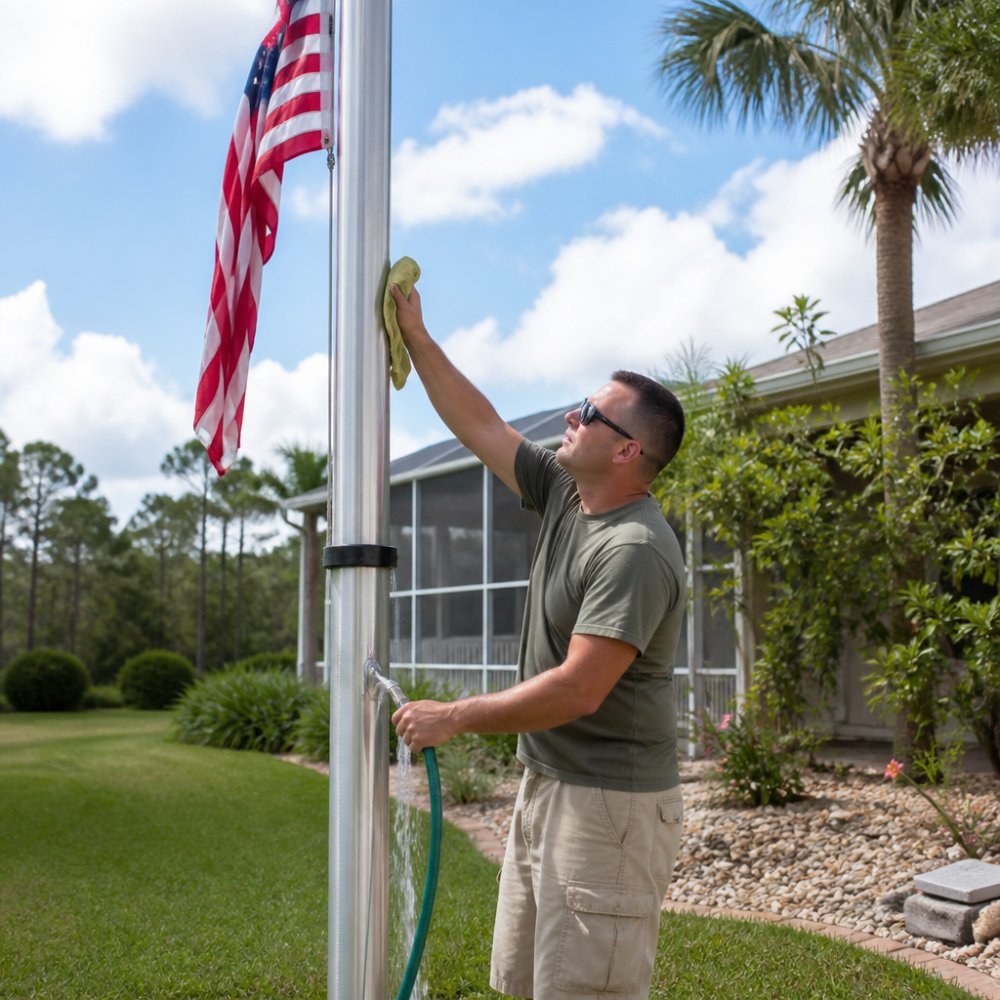
Washing the Pole Sections
Follow these steps for a thorough clean:
- Lower the flag and remove it from the snap hooks.
- Retract the pole fully before washing.
- Mix a few drops of mild detergent with warm water.
- Wipe each section with a soft cloth, working top to bottom.
- Rinse with a garden hose.
- Dry with a clean towel to prevent water spots.
Use a non-abrasive cleaner only. Harsh chemicals strip the surface finish and speed up oxidation.
Cleaning the Flag and Halyard
Your flag and halyard take the same beating as the pole. Wash the flag by hand in cool water with mild detergent, then let it air dry. Check the halyard and swivel harness for fraying. Replace any worn snap hooks before they fail in a gust.
How to Extend and Retract Your Pole Safely
Extend from the bottom section up, and retract from the top down. This keeps the pole balanced and puts less stress on the locking mechanism.
Safety protocols for tall poles:
- Never extend a pole near power lines.
- Lower your pole before storms with sustained winds.
- On poles over 20 feet, have a second person spot you.
- Never stand directly under the pole while extending it.
Troubleshooting Telescoping Flagpole Sections That Stick or Slip
Most section problems trace back to dirt, debris, or a worn locking pin. Here's how to fix each one.
When Sections Won't Extend
Sticking sections usually mean grit has built up inside the joint. Retract the pole, wipe down each section with a damp cloth, and let it dry fully. Check for small dents or bends that block travel. If a section still won't move, do not force it. Forcing a stuck section can bend the aluminum and ruin the pole.
When the Pole Won't Stay Up
A pole that slips down has a locking pin problem. Inspect the pin at each joint. If a pin is worn or bent, replace it. Never try to bend a pin back into shape.
Problem |
Likely Cause |
Fix |
|---|---|---|
Sections won't extend |
Dirt or debris in joint |
Clean and dry sections |
Pole slips down |
Worn locking pin |
Replace the pin |
Section bends |
Forcing a stuck joint |
Stop, inspect, clean |
Halyard tangles |
Worn swivel harness |
Replace harness |
Flagpole Hardware Replacement and Inspection Schedule
Component |
What to Check |
Replace When |
Typical Service Life |
|---|---|---|---|
Locking pins (each joint) |
Bent shaft, rounded tip, weak spring return |
Pin no longer seats with a firm click, or tip is visibly rounded |
2-4 years with regular use |
Snap hooks |
Rust, stretched gate, sharp edges |
Gate won't close flush or rust pits the metal |
1-2 years in coastal air |
Swivel harness |
Frayed webbing, stiff or seized swivel |
Any fraying, or swivel no longer turns freely |
2-3 years |
Halyard |
Fraying, UV brittleness, flat spots |
Fraying at the clip or sheave contact point |
2-3 years |
Ground sleeve |
Cracks, tilting, water pooling inside |
Any crack, or the sleeve moves when the pole is inserted |
Inspect annually |
Base and flash collar |
Paint blistering, white oxidation, rust bleed |
Corrosion reaches bare metal |
Inspect annually |
A note on replacement parts. Match the pin diameter and spring tension to the original. A pin that is too short will not seat fully; one that is too stiff will not release by hand. If you are unsure of the size, measure the old pin with calipers before ordering.
Telescoping Flagpole Winter Maintenance and Storage
Cold weather is the single most destructive season for a telescoping flagpole, and most guides stop at "bring it inside." The real problem is water. Moisture trapped between sections freezes, expands, and can crack a joint or seize a section permanently. The fix is a specific pre-freeze and spring-thaw protocol, not a vague suggestion to store it.
Why Freeze-Thaw Damages Telescoping Poles
Aluminum expands and contracts with temperature, but water expands far more when it turns to ice, roughly 9 percent by volume. That expansion happens inside the tight clearance between telescoping sections, where there is nowhere for the ice to go. The result is a seized joint in the best case and a cracked or deformed section in the worst. A pole that was extended when the first hard freeze hit is the most vulnerable, because water has pooled at every joint.
Pre-Freeze Protocol
Before the first hard freeze in your area:
- Lower the flag and remove it from the snap hooks.
- Retract the pole fully so no joint is left extended.
- Wash the pole with mild detergent and rinse with fresh water.
- Dry every section by hand with a clean towel, do not rely on air drying, which leaves moisture in the joints.
- Let the pole sit retracted indoors for 24 hours to release any condensation before storage.
- Store the pole horizontally indoors or in a shed if you can. Horizontal storage keeps water from pooling at the base joint.
If the Pole Stays Outside
Many owners leave the pole up year-round. If you do:
- Keep the pole fully retracted. A retracted pole has far less surface area for ice to grip and far less stress on the locking pins.
- Cover the top with a breathable cap or wrap. A non-breathable cover traps condensation inside, which is worse than leaving it open.
- Check the ground sleeve for standing water after every thaw. Water that pools in the sleeve is the leading cause of base corrosion.
- Do not extend the pole during or immediately after a freeze. Wait for a full thaw and a dry day.
Spring Thaw Check
When temperatures stay above freezing, inspect before you extend:
- Look inside each joint for condensation or grit.
- Wipe each section dry with a clean cloth.
- Press each locking pin by hand to confirm it snaps back freely.
- Extend the pole slowly, one section at a time, listening for a firm click at every joint.
If a section will not extend, do not force it. A stuck section after winter is usually ice or grit in the joint, not a bent pole. Retract, clean, dry, and try again.
Corrosion Prevention for Coastal and High-Wind Areas
Salt spray is the number one enemy of any flagpole. Coastal owners should rinse their pole with fresh water every two to four weeks. That single habit removes salt before it starts the oxidation process.
Frequently Asked Questions
How often should I clean my telescoping flagpole?
Clean your telescoping flagpole every three to six months, and more often in coastal areas where salt spray builds up quickly. Use a mild detergent mixed with water and a soft cloth or non-abrasive cleaner. Rinse with a garden hose and let the pole air dry before retracting. Regular cleaning removes dirt and debris that cause friction between telescoping sections, which keeps the pole extending and retracting smoothly.
Can I use lubricant on my telescoping flagpole?
No. Do not apply WD-40 or any other lubricant to your telescoping flagpole. Lubricants attract dust and grit, which collect inside the telescoping sections and cause the locking mechanism to slip or jam over time. Instead, keep sections clean and dry. If a section feels stiff, inspect it for debris or surface oxidation and wipe it down with a damp cloth. Proper cleaning is the only maintenance the sections need.
Why is my telescoping flagpole not staying up?
A telescoping flagpole that won't stay extended usually has debris trapped in the locking mechanism or worn internal components. First, fully retract the pole, wipe each section with a soft cloth, and extend it again slowly. If the pole still slips, inspect the locking collars for cracks or wear. The pole carries a 15-year all-weather warranty that covers structural defects.
How do I prepare my telescoping flagpole for winter?
Retract the pole fully and remove the flag before the first hard freeze. Clean each section with a mild detergent, rinse with a garden hose, and dry thoroughly to prevent condensation from freezing inside the telescoping sections. Store the pole indoors or in a garage if possible. If you leave it mounted, keep it in the retracted position and check the ground sleeve for water accumulation that could freeze and crack the base.
Maintaining a telescoping flagpole is a habit, not a chore. Clean it, inspect it, and store it right, and it will keep flying for years. Armor Flagpoles offers poles for exactly that kind of long-term use, with 7000-T8 aluminum, 10-gauge thickness, and a 15-year warranty. Get started with Armor Flagpoles and fly your flag with confidence in any weather.