

How to Properly Light a Flag at Night: 2026 Guide
Table of Contents
- What You'll Need Before You Light a Flag at Night
- U.S. Flag Code Lighting Requirements: What Federal Law Says
- Step 1: Choose the Right Fixture for Your Flagpole
- Step 2: Best Solar Flagpole Lights and Wiring Options
- Step 3: Mount and Position the Light for Full Coverage
- Step 4: Weatherproof the Setup and Keep It Running
- Common Mistakes to Avoid When You Light a Flag at Night
- Conclusion
- Frequently Asked Questions
Last Updated: September 28, 2026
What You'll Need Before You Light a Flag at Night
Learning how to properly light a flag at night starts with one hard fact: the U.S. Flag Code expects a flag to be illuminated if it stays up after dark. At Armor Flagpoles, we've watched too many homeowners get this wrong with a weak porch light and a hopeful glance. This guide walks you through fixtures, wiring, mounting, and weatherproofing, step by step.
Gather these items first:
- A dedicated flagpole light (solar or wired)
- The correct mounting bracket for your pole
- A ladder and a helper
- Cable clips or zip ties
- A dusk-to-dawn sensor or timer
- Basic hand tools
Most failed night displays trace back to one missing item: a light made for the job.
U.S. Flag Code Lighting Requirements: What Federal Law Says
Federal law does not demand you take the flag down at sunset. It offers a clear alternative. The U.S. Flag Code, Title 4, Chapter 1 states that the flag may fly at night if it is properly illuminated. That single word, "illuminated," drives every decision in this guide.
The Illumination Exception for Night Display
Proper illumination means the flag stays visible in hours of darkness, not just lit near the pole base. A dim glow that leaves the stars and stripes in shadow does not meet the standard. The goal is a patriotic effect: the flag should read clearly from the street, the way it does at noon.
Step 1: Choose the Right Fixture for Your Flagpole
The right fixture depends on your pole height, your flag size, and how much reach you need. Two styles dominate: top-mounted and ground-mounted. Each has a trade-off.
Fixture Type |
Best For |
Trade-off |
|---|---|---|
Top-mounted |
Clean look, no wiring |
Needs a bright, focused head |
Ground-mounted |
Larger flags, more reach |
Requires power or a long run |
Solar top-mounted |
Quick setup, no outlet |
Output drops on cloudy days |
Low-voltage wired |
Consistent all-night light |
Needs a transformer |
Top-Mounted vs. Ground-Mounted and Beam Angle
A top-mounted fixture sits above the flag and throws light down the pole. It hides the hardware and avoids glare at eye level. A ground-mounted LED floodlight aims up from the base and works well for tall poles and big flags.
Beam angle matters as much as brightness. A narrow beam concentrates light on the flag. A wide beam spills everywhere and wastes output. For most home poles, a focused beam between 30 and 45 degrees covers the flag without lighting up the whole yard. Our pole lights use a 266-LED head at a 45-degree angle, which spreads an even wash across the fabric.
Matching Light Output to Flag Size and Pole Height
Most guides skip the math, but the numbers matter. A flag that is 3x5 feet on a 20-foot pole needs far less light than a 5x8 flag on a 25-foot pole. The goal is even coverage, not a hotspot. As a rule of thumb, a top-mounted head with a focused beam and a high LED count will cover a standard residential flag, while larger flags on taller poles need either a brighter head or a second fixture aimed from the base.
A common pattern is to start with a single top-mounted unit and check coverage from the street. If the fly end or the top corner falls into shadow, add a ground-mounted fill light or step up to a higher-output head. A 566-LED all-night head is built for setups that need full brightness from dusk to dawn without a dimming curve.
Mounting Options and Hardware
Mounting hardware decides whether the beam stays put. A bracket that clamps the head to the pole keeps it from twisting in wind. Zip ties and tape fail within weeks. For top-mounted units, look for a bracket that fits your pole's diameter and locks the angle.
Step 2: Best Solar Flagpole Lights and Wiring Options
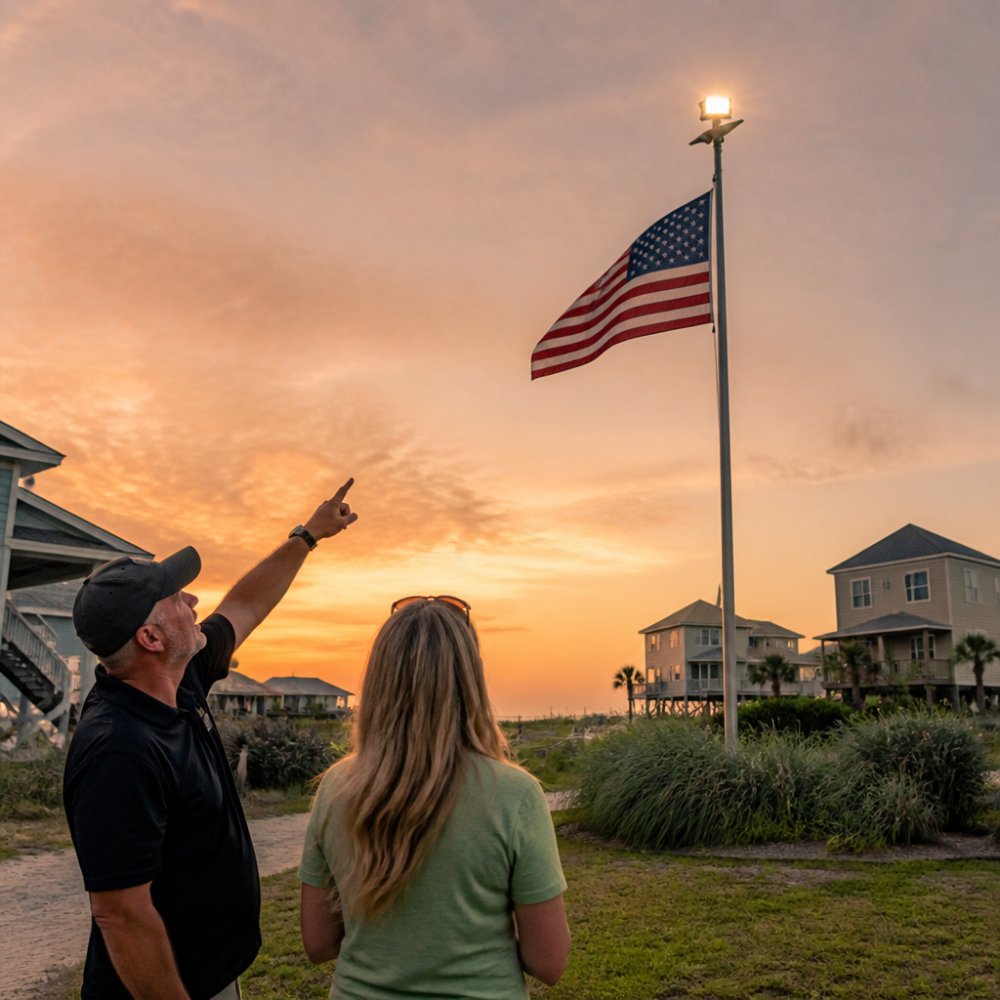
For most homeowners, the best solar flagpole lights win on convenience: no trench, no outlet, no electrician. A solar-powered light charges by day and runs on a dusk-to-dawn sensor at night. Mount it at the top of the pole and it turns itself on.
20 Ft Superior 1 Telescoping Flagpole Kit →
Lumen Output and Light Trespass
Two numbers decide whether your setup works. Lumen output is total brightness. Light trespass is the light that escapes your property and annoys the neighbors.
Step 3: Mount and Position the Light for Full Coverage
Position the light so the entire flag, from hoist to fly, catches the beam. A single light at the base often misses the top corner. That is where triangulation helps: use the pole, the flag's span, and the light's angle to find the sweet spot.
Follow these steps:
- Set the light at the top of the pole for a downward wash.
- Angle the head so the beam hits the flag's full width.
- Check coverage from the street, not just the yard.
- Adjust the angle until no corner falls into shadow.
- Lock the mounting bracket so wind cannot shift it.
Step 4: Weatherproof the Setup and Keep It Running
Water and wind kill cheap setups. Choose weather-resistant hardware rated for outdoor use. Seal every connection and route the cable down the pole with clips so it does not slap in the wind. If you live on the coast, salt spray will find any weak point, so check fittings each season.
Salt, Wind, and UV: The Three Killers
Coastal and storm-prone areas punish flagpole lighting in three ways. Salt spray corrodes exposed metal and seeps into connections. Wind works loose brackets and whips cables until they fray. UV breaks down plastic housings and wire insulation. The fix is to choose hardware rated for outdoor use, seal every connection with dielectric grease or heat-shrink tubing, and route cable inside the pole or tight against it with clips.
Seasonal Maintenance Checklist
- Clean the solar panel monthly to keep charging at full output.
- Tighten bracket bolts and cable clips each season.
- Inspect wire insulation for cracks or UV damage.
- Test the dusk-to-dawn sensor by covering it and watching the light come on.
- Check the flag for fraying, since a torn flag catches wind and strains the pole.
Common Mistakes to Avoid When You Light a Flag at Night
Most night-display problems come from a short list of errors. Fix these and your setup runs for years.
- Using a porch light instead of a dedicated fixture
- Aiming the beam at the pole, not the flag
- Choosing a beam so wide it lights the whole block
- Ignoring light trespass and irritating neighbors
- Leaving connections exposed to rain and salt
- Forgetting to clean the solar panel so it keeps charging
Conclusion
Getting the light right takes one careful setup, then it runs itself. The payoff is a flag that looks sharp at midnight and a display that respects the law and your neighbors. Armor Flagpoles builds poles that hold steady through wind, salt, and storm, with 7000 T8 aluminum, 10-gauge thickness, and a 15-year factory warranty.
Frequently Asked Questions
Is it illegal to fly a flag at night without a light on it?
Federal law does not make it a crime. The U.S. Flag Code (4 U.S.C. Section 6) states that the flag should not be displayed at night unless it is properly illuminated. The code carries no penalty, but it sets the standard most homeowners and businesses follow. If you cannot light the flag, lower it at dusk and raise it again in the morning. For the full text, see the official U.S. Flag Code on a .gov site.
What are the US flag code lighting requirements for nighttime display?
The U.S. Flag Code requires that a flag displayed during hours of darkness be illuminated so it stays visible and recognizable. There is no federal lumen number, but the display should read as a flag, not a dim shape. In practice, a dedicated flagpole light with a dusk-to-dawn sensor or photocell keeps the flag lit from dusk until sunrise so you never have to switch it on and off by hand.
Can I use solar lighting for my flagpole?
Yes. Solar flagpole lights are one of the easiest ways to meet the illumination standard because they need no wiring and use a photocell to turn on at dusk. Look for an LED fixture with enough lumen output to reach the top of the flag, a wide beam angle, and a weather-resistant housing. In high-wind or coastal areas, choose a mount that holds the fixture steady so the beam stays on the flag all night.
What is the best angle for flagpole lighting?
Aim the fixture so the beam spreads across the full flag, not just the pole. Ground-mounted lights typically angle upward at about 45 degrees, which covers the fly end and the field without hot spots. Top-mounted lights sit above the flag and shine down. Either way, check the beam angle and adjust at night so the stars and stripes stay evenly lit from dusk to dawn.
A flag that stays lit all night starts with a pole that never quits. Armor Flagpoles gives you tanker-tough strength, transparent specs, and hardware built to last. Get started with Armor Flagpoles and fly your colors with confidence after dark. Solar lights included with all kits.