

What Is the Required Height for a Residential Memorial Flagpole?
Last Updated: November 4, 2026
Quick Summary
There is no single legally required height for a residential memorial flagpole. Common choices are 16 feet for lower homes and 20 feet for taller homes or larger yards, but local zoning and HOA rules can limit the height you can install.
- Check with your city, county, or homeowners association before installing a residential memorial flagpole.
- A 16-foot pole suits single-story homes and smaller lots.
- A 20-foot pole suits taller homes or larger yards.
- Check actual roof and tree clearance from the installation spot before choosing a height.
- Contact 811 to mark buried utility lines before you dig.
Table of Contents
- Is There a Legally Required Height for a Residential Memorial Flagpole?
- Choosing a Residential Flagpole Height for Your Property
- Matching Flag Size to Your Flagpole
- Flagpole Height and Burial Depth Explained
- Residential Flagpole Placement for a Respectful Memorial Display
- Local Rules, Permits, and HOA Restrictions to Check First
- Choosing Your Memorial Flagpole Kit
- Frequently Asked Questions
Is There a Legally Required Height for a Residential Memorial Flagpole?
Many homeowners searching for the required height for a residential memorial flagpole expect a single legal number. Height guidance you find online is usually a common practice, not a rule.
That said, local rules can still shape your choice. Check with your city, county, or homeowners association before you install. Our residential flagpole placement rules and etiquette guide walks through what to check first.
Choosing a Residential Flagpole Height for Your Property
Height is usually chosen based on the size of your home and yard.
Here is how to think about it:
- Single-story home: A 16-foot pole suits lower roofs and smaller lots.
- Taller homes or larger yards: A 20-foot pole gives the flag more presence.
- Two-story homes and wide properties: Taller poles help the display stand out.
Our 16 Ft Classic Telescoping Flagpole Kit suits lower homes and camper setups. If you need more height, the 20 Ft Superior 1 Telescoping Flagpole Kit gives you extra clearance.


Checking Roof and Tree Clearance
Before you pick a height, look up at your roofline and nearby trees. A pole that reaches past the roof edge can look awkward, and branches can rub the flag. Always check actual roof clearance from the spot where you plan to install.
Matching Flag Size to Your Flagpole
A good flag should look proportional to the pole. A small flag on a tall pole can look lost, and a large flag on a short pole can look crowded.
Common pairings include:
- 3 × 5-foot flag on a 16-foot pole
- 4 × 6-foot flag on a 20- to 25-foot pole
Telescoping and sectional poles each have strengths. Our guide on telescoping vs sectional flagpoles for residential use explains the differences.
Flagpole Height and Burial Depth Explained
Taller poles carry more sail area, so the base does more work. The ground sleeve is only as good as the hole it sits in.
How the Ground Sleeve Works
Most telescoping kits use a ground sleeve that stays in the ground while the pole lifts out for service. The sleeve is set in concrete or firmly compacted soil, and the pole slides down inside it. An open bottom lets water drain out instead of pooling inside the pole. A bottom stop bolt sets how far the pole drops in, and an adjustment screw lets you fine-tune the fit and take up play.
Footing Depth and Diameter Basics
Exact footing dimensions come from your model's installation instructions, so follow those first. Footing dimensions and depth depend on local conditions, so consult the installation instructions and a local professional.
Call 811 Before You Dig
Before digging, contact the 811 call-before-you-dig service to have buried utility lines marked.
Plan the footing location around those marks.
Setting the Sleeve Plumb
A sleeve that is off-plumb sets the whole pole off-plumb. Follow the product instructions for setting and curing the sleeve.
Matching Depth to Pole Height
A 16-foot pole and a 20-foot pole present different loads to the footing.
For hitch-mount setups, there is no footing at all. Instead, check the mount's receiver against the pole's base diameter: 2.4 inches for the 16 Ft Classic and 2.75 inches for the 20 Ft Superior 1. Confirm the mount's adjustment screw and bottom stop bolt engage the pole properly, and that the open bottom can drain.
16 Ft Classic Telescoping Flagpole Kit →
The table below sums up the key installation details covered in this section.
| Item | Value | Note |
|---|---|---|
| Ground sleeve | Stays in the ground | Pole lifts out for service |
| Sleeve setting | Concrete or firmly compacted soil | Follow product instructions |
| Bottom | Open | Lets water drain out |
| Bottom stop bolt | Sets pole drop-in depth | Fine-tune fit with adjustment screw |
| Utility lines | Contact 811 before digging | Plan footing around marks |
| Hitch-mount base, 16 Ft Classic | 2.4 inches | Check receiver fit |
| Hitch-mount base, 20 Ft Superior 1 | 2.75 inches | Check receiver fit |
Residential Flagpole Placement for a Respectful Memorial Display
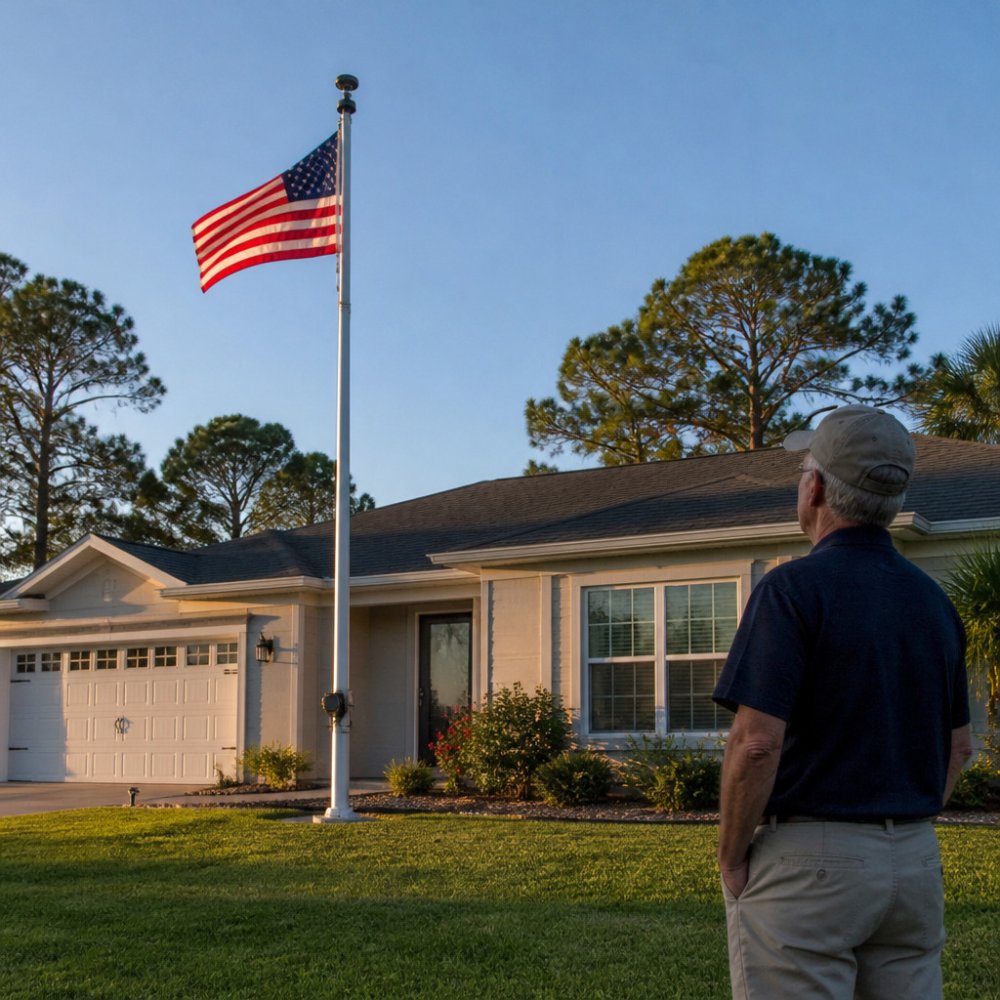
Choose a spot where the flag does not block walkways or windows.
Local Rules, Permits, and HOA Restrictions to Check First
Local rules can affect a residential memorial flagpole. Zoning codes, permit offices, and homeowners associations each control a different piece of the puzzle. A short round of calls before you buy saves you from re-digging a footing later.
Start With the Zoning or Permit Office
Call your city or county planning or permit office and ask three questions. First, is a permit required for a ground-set flagpole at a single-family home? Second, is there a maximum height limit for accessory structures or flagpoles? Third, are there setback rules that keep the pole a certain distance from property lines?
Write down the answers and the name of the person who gave them. Rules vary widely from one jurisdiction to the next, and a written record helps if a question comes up later.
Check Easements and Utility Corridors
Many front yards have a public utility easement along the street. An easement gives the utility the right to dig, which means a pole placed inside one could be moved at your expense. Ask the permit office or your title documents where easements run on your lot.
Overhead power lines are a separate concern. Keep the pole and the flag's swing clear of any line, and never install where a raised flag could contact a wire.
Read the HOA Rules Before You Buy
If you live under a homeowners association, its rules can be stricter than the city's. Ask for the architectural review guidelines and any flag or flagpole provisions in the covenants. Some associations cap pole height, limit placement to the back yard, or require approval before installation.
Submit the approval request early. A conditional approval with a height limit tells you which pole to choose before you order.
Understand Flag Display Etiquette
Check whether your association has rules on additional flags or memorial banners.
Keep a Simple Record
Keep copies of your permit, HOA approval, utility locate ticket, and installation instructions together. If you sell the home, that record answers buyer questions about the pole and its footing. It also helps if a future code question arises.
Skipping the HOA step can lead to a costly change, because an association can require removal of a pole that was never approved.
Choosing Your Memorial Flagpole Kit
Pick a kit that matches your home height and flag size. We select the included flag, solar light, and flag hardware to match the specific pole, so you do not need to find compatible components on your own.
- 16 Ft Classic Telescoping Flagpole Kit: Built for lower homes and campers, with a 2.4-inch base.
- 20 Ft Superior 1 Telescoping Flagpole Kit: A good fit for taller homes, with a 2¾-inch base.
For hitch-mount use, check compatibility against the pole's base diameter. The 16 Ft Classic has a 2.4-inch base and the 20 Ft Superior 1 has a 2.75-inch base. Taller RVs and fifth wheels need the 20-foot Superior 1 for flag clearance, and you should always check actual roof clearance first.
Frequently Asked Questions
How high should a residential flagpole be?
Height is usually chosen based on the size of your home and yard. Many homeowners choose a height that keeps the flag above the roofline with room to spare. Measure your home's height and the size of the flag you plan to fly before deciding. Armor Flagpoles offers a 16 Ft Classic, a 20 Ft Superior 1, and 20 and 25 Ft Superior 2 kits, so you can match a pole to your property.
Is there a required height for a residential memorial flagpole?
Many homeowners choose a height based on the house, the yard, and the flag size. Before installing, check with your local government and homeowners association for any rules about height or placement. A pole that is proportional to the home and placed with respect for the memorial purpose is a sound approach.
How deep should a 25-foot flagpole be buried?
Burial depth depends on the pole, the soil, and local conditions, so follow the installation instructions included with your kit. The 25 Ft Heavy Duty Superior 2 Telescoping Flagpole Kit includes a custom ground sleeve for ground installation. Avoid guessing the depth, and confirm the foundation approach suits your soil before digging. Check for underground utilities before any excavation.
