

How to Prevent Flagpole Vibration in High Winds
Table of Contents
- Why Flagpoles Vibrate in High Winds (and What It Signals)
- How to Stop a Flagpole From Shaking: A Step-by-Step Fix
- Flagpole Ground Sleeve Installation: The Foundation That Stops the Shake
- Flagpole Wind Rating: What the Numbers Actually Tell You
- Stop Flag Wrapping Around the Pole in Gusty Conditions
- Pole Material, Diameter, and Wall Thickness: What Resists Vibration Best
- Wind Speed Thresholds: When to Lower Your Flag
- RV and Portable Mounting: Keeping a Telescoping Pole Steady on the Move
- Conclusion: A Steady Flag Starts With the Right Setup
- Frequently Asked Questions
Last Updated: October 8, 2026
Why Flagpoles Vibrate in High Winds (and What It Signals)
Flagpole vibration is the rapid back-and-forth shaking a pole develops when wind moves past it, and it usually signals a setup problem rather than a wind problem. At Armor Flagpoles, we see this question most often from coastal and high-wind customers. The pole is telling you something.
Wind rarely pushes a pole in one steady direction. It curls around the pole and sheds off in alternating swirls. Each swirl nudges the pole sideways. When those nudges match the pole's natural sway, the shaking builds.
This is called vortex shedding, and it is the same force that makes power lines hum. The National Weather Service wind safety guidance notes that gusty conditions put far more stress on tall structures than steady wind does.
Here is the part most guides miss: vibration and flag flutter are two different problems. A snapping flag is normal. A pole that buzzes, hums, or visibly shivers is not.
That distinction matters, because the fixes are different.
How to Stop a Flagpole From Shaking: A Step-by-Step Fix
The fastest way to stop a flagpole from shaking is to work from the ground up: check the base, then the hardware, then the flag. Most shaking traces back to one of those three.
Follow this order. Skipping ahead wastes time.
- Check the ground sleeve and sand pack
- Tighten every fastener and inspect the swivel
- Confirm the flag is attached correctly
- Test at low height before full extension
- Recheck after the next windy day
Most people jump straight to buying a heavier pole. That is usually the last step, not the first.
Step 1: Check the Ground Sleeve and Sand Pack First
A loose base lets the whole pole rock, and rocking reads as vibration at the top. The ground sleeve must sit below the frost line and stay packed tight.
Use clean, coarse sand, not dirt or fine play sand. Fine sand shifts and settles. Coarse sand locks together.
Pack it in layers. Add a few inches, tamp it down, then repeat. Do this all the way up. A properly packed sleeve holds the pole like a fist.
Step 2: Tighten Fasteners and Inspect the Swivel System
Loose hardware is the second most common cause of a shaking flagpole. Work through every connection point.
- Tighten all stainless-steel clips and spring-loaded fasteners
- Check the pole-top ball-bearing swivel for grit or wear
- Look for bent or stretched retainer rings
- Confirm each telescoping section locks fully
A swivel that binds forces the flag to pull against the pole. That tug travels down the shaft as a shake. On our Superior 2 kits, the pole-top ball-bearing swivel and white beaded retainer rings are built to let the flag rotate freely with wind direction changes.

If the swivel grinds instead of spinning, clean it before you tighten anything else.
Flagpole Ground Sleeve Installation: The Foundation That Stops the Shake
Flagpole ground sleeve installation is the single biggest factor in whether a pole stays steady, because the sleeve transfers every wind load into the ground. Get this wrong and no pole will hold still.
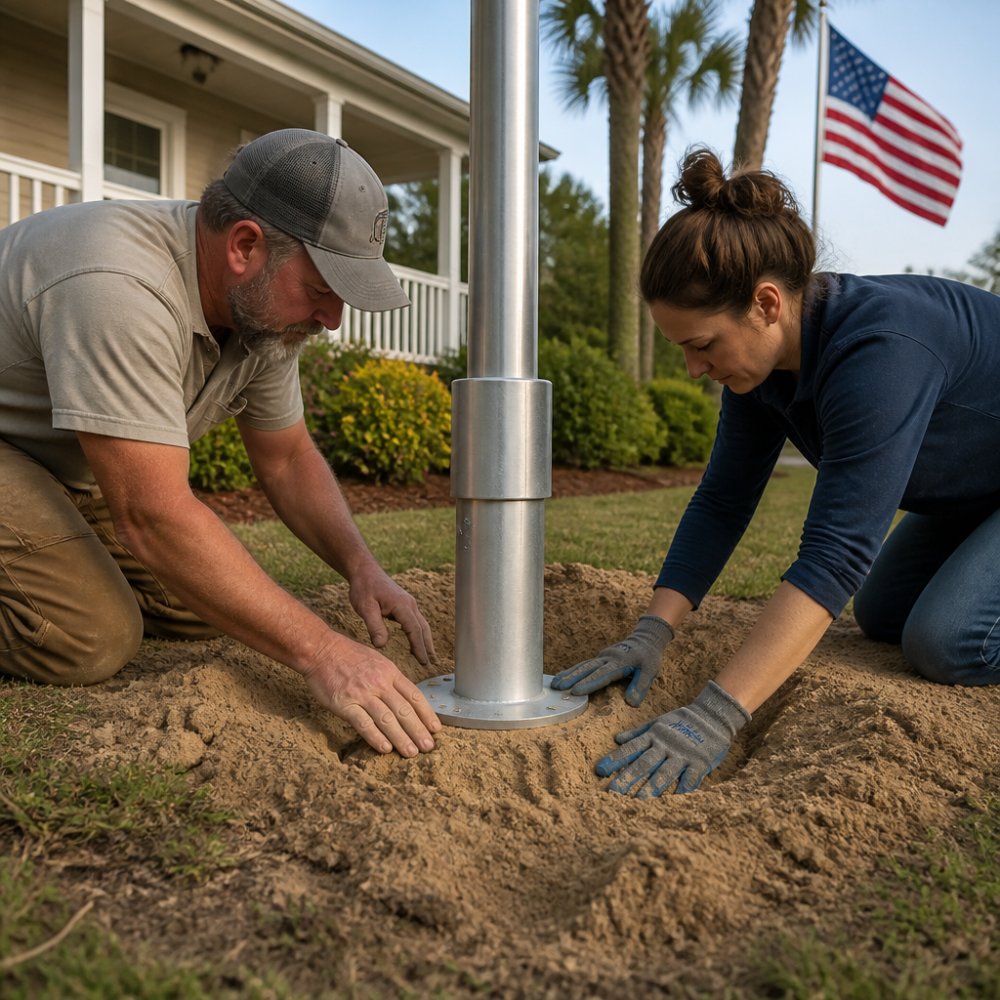
Here is how to do it:
- Dig the hole wider than the sleeve, then set the sleeve plumb
- Add a gravel layer at the bottom for drainage
- Lower the pole in and check level on two sides
- Pour coarse sand in 4-inch layers
- Tamp each layer firmly before adding the next
- Slide the flash collar down to finish the top
The galvanized-steel flash collar on our kits keeps water and debris out of the gap. That protects the sand pack from washing away over time.
Sand choice matters more than most people expect. Coarse, angular sand grips the sleeve. Round, fine sand acts like ball bearings. If your pole still rocks after a proper pack, the sand is the first thing to check.
Flagpole Wind Rating: What the Numbers Actually Tell You
A flagpole wind rating is the maximum sustained wind speed a pole is designed to handle with a flag attached, and it is the number most buyers misread. The rating assumes a specific flag size, a specific exposed pole height, and a properly installed base. Change any one of those and the rating no longer applies.
The reason is resonance. Every pole has a natural frequency, the rate at which it prefers to sway. Wind shedding off the pole in alternating swirls produces its own frequency, called the vortex-shedding frequency. When the two line up, the pole amplifies the motion instead of damping it. That is why a pole can hum in a 15 mph breeze but sit still in a steady 25 mph blow: the wind speed, not just the wind strength, decides whether the frequencies match.
So when you compare poles, ask four questions:
|
What to Check |
Why It Matters |
What to Look For |
|---|---|---|
|
Base diameter |
Wider base spreads bending load over more metal |
3½-inch base on heavy-duty telescoping models |
|
Wall thickness |
Thicker walls raise stiffness and shift natural frequency |
10-gauge aluminum |
|
Exposed height |
Taller exposed sections sway more and lower natural frequency |
Match height to rating, not to preference |
|
Flag size |
Bigger flags add sail area and load |
Match flag to pole height and rating |
A pole rated for high wind with a small flag may fail with a large one. That is not a defect. It is physics.
Wind-Speed Thresholds: When to Lower the Flag
Most sources use sustained winds of roughly 25 to 30 mph as a practical cutoff for lowering a flag on a residential telescoping pole. Gusts matter more than sustained speed, because a gust can briefly double the load and push the pole into a visible shiver.
Use these signs as your real-world threshold, regardless of the number on the box:
- The pole hums or buzzes, a sign the shedding frequency has matched the pole's natural frequency
- The top section whips out of line with the lower sections
- The flag snaps hard enough to jerk the pole on each gust
- The base or flash collar shows any movement
If you see any of these, lower the pole. On a telescoping design that is a one-person job with no halyard to fight.
For coastal and waterfront setups, keep a second, smaller flag on hand for storm season. Less sail area means less load and a higher effective wind rating for the same pole.
20 Ft Heavy Duty Superior 2 Telescoping Flagpole Kit →
Stop Flag Wrapping Around the Pole in Gusty Conditions
Flag wrapping happens when the flag loses its ability to rotate with the wind, so it coils around the shaft instead of streaming. The fix is almost always in the attachment hardware.
When a flag wraps, it stops acting like a sail and starts acting like a rope. That changes the load on the pole and can add to the shake.
Three things stop wrapping:
- A swivel that turns freely at the top
- Retainer rings that let the flag slide and rotate
- Correct clip tension so the flag is not pinned in place
Lowering a telescoping pole to reach the attachments makes this easy to check. You can inspect the swivel and rings without a ladder or a halyard.
Pole Material, Diameter, and Wall Thickness: What Resists Vibration Best
Stiffness, not material name, is what resists vibration. Stiffness comes from three things working together: the alloy, the diameter, and the wall thickness. Change any one and the pole's natural frequency shifts, which changes whether it will hum in a given wind.
Common materials include:
- Thick-wall 7000-series aluminum: Stiff, strong, and built to flex without failing
Diameter matters more than most buyers realize. A wider base spreads the bending force over more metal and raises the pole's natural frequency, which pushes it out of the range where ordinary wind gusts can drive resonance. That is why heavy-duty telescoping poles use a wide base section and taper toward the top, the taper matches stiffness to the bending load, which is highest at the base and lowest at the tip.
Wall thickness is the spec most buyers ignore. A 10-gauge wall carries far more load than a thin sheet-metal tube of the same diameter. The extra metal raises stiffness, which raises the natural frequency, which moves the pole away from the shedding frequencies that cause humming.
Why Telescoping Sections Change the Math
A telescoping pole is not one tube, it is several nested tubes, each with its own stiffness. The joints between sections are the weak points, because a joint is never as stiff as the continuous tube around it. A pole with five sections has four joints, and each one is a place where vibration can start.
That is why the order of fixes matters. Before you blame the material, check that every section locks fully and that no joint has play. A pole with a loose joint will hum even if the alloy and wall thickness are correct.
Wind Speed Thresholds: When to Lower Your Flag
Lower your flag when sustained winds reach roughly 25 to 30 mph, or when gusts start pushing the pole into a visible shiver. That range is often used as a practical cutoff.
The exact number depends on your pole and flag size. A small flag on a stout pole handles more wind than a large flag on a light pole.
Watch for these signs:
- The pole hums or buzzes
- The top section whips out of line
- The flag snaps hard enough to jerk the pole
- The base shows any movement
If you see any of these, lower the pole. A telescoping design makes that a one-person job.
For coastal and waterfront setups, keep a second, smaller flag on hand for storm season. Less sail area means less load.
RV and Portable Mounting: Keeping a Telescoping Pole Steady on the Move
A portable flagpole on an RV stays steady when the mount is rigid and the pole is lowered before travel. The pole is rarely the weak point. The mount usually is.
For RV and campsite use:
- Use a dedicated pole mount or hitch mount, not a bungee
- Anchor to a solid frame point, never thin body panels
- Lower the pole fully before you drive
- Check fasteners after every move
A telescoping pole is a good fit for mobile use because it collapses to a manageable size and needs no halyard. You raise and lower it by hand.
For ground setups at a campsite, a ground mount or a weighted stand works well. Pack the base tight and check it after any strong gust.
Conclusion: A Steady Flag Starts With the Right Setup
Fighting flagpole vibration in high winds comes down to three things: a solid base, tight hardware, and a pole built to take the load.
When you are ready for a pole that holds up, Armor Flagpoles provides heavy-duty telescoping flagpoles from 10-gauge 7000-T8 aluminum, made in the USA and backed by a 15-year pole warranty. Our kits include the ground sleeve, flash collar, and ball-bearing swivel system that keep a flag steady in real wind.
Get started with Armor Flagpoles and set up a flag display.
Frequently Asked Questions
What causes a flagpole to vibrate in high winds?
Vibration happens when wind moves past the pole and creates alternating low-pressure pockets on each side, a process called vortex shedding. When those pulses match the pole's natural frequency, the pole starts to oscillate. A flag that is too large for the pole, a loose ground sleeve, or worn swivel hardware can all make flagpole vibration worse. A properly sized, rigid pole with a secure mount and correctly packed ground sleeve resists this motion far better.
How do I check whether a flagpole is secure in its ground sleeve?
Lower the telescoping pole and remove it from the sleeve. Look for cracks in the sleeve, a loose flash collar, or sand that has settled or washed out. Refill with clean, coarse sand and pack it down firmly in layers around the pole. A pole that still shifts side to side after repacking needs a deeper or wider sleeve, or a fresh installation with proper drainage gravel at the bottom.
Should I take my flag down during high winds?
Most residential flags are rated for moderate breezes, and sustained gusts above 30 to 35 mph put stress on both the flag and the pole. Lowering the flag, or removing it entirely, reduces wind drag and the load on the swivel and clips. If your area regularly sees stronger gusts, choose a pole with a higher wind rating and a flag sized to match the pole's height and diameter.
Why does my flag keep wrapping around the pole?
Flag wrapping happens when wind direction shifts faster than the flag can rotate. A pole-top ball-bearing swivel system and beaded retainer rings let the flag pivot freely, which cuts down on tangling. Check that the swivel spins without grit or stiffness, that the clips are snug, and that the flag is not oversized for the pole. A flag weight attached to the bottom ring also helps keep the fabric hanging down in gusty conditions.