

Is a 20 Foot Flagpole Too Tall for a Single Story House?
Last Updated: October 25, 2026
Quick Summary
Whether is a 20 foot flagpole too tall for a single story house depends on your lot size, roofline, and sightlines. For most single-story homes, a 20-foot pole is proportionate when its top lands 2 to 6 feet above the roofline peak with open sightlines. On compact lots with low rooflines, a 16-foot pole usually fits better.
- A 20-foot pole's exposed height is roughly 18 to 18.5 feet after ground installation.
- Pole top should land 2 to 6 feet above your roofline peak for balanced proportion.
- Setback distance affects how tall a pole appears; 25 feet back reads shorter than 10 feet.
- A 4×6 flag suits a 20-foot pole; a 3×5 flag looks undersized on that height.
- Check local zoning height limits, setback minimums, and easement lines before installation.
Table of Contents
- Understanding Residential Flagpole Height for Single-Story Homes
- The 20-Foot Flagpole: Does It Fit Your Home's Scale?
- Recommended Flag Size for a 20-Foot Flagpole
- Where to Place a Flagpole in Front of a House
- Residential Flagpole Installation Basics
- Comparing 20-Foot and 16-Foot Options
- Choosing Your 20-Foot Flagpole Setup
- Frequently Asked Questions
Understanding Residential Flagpole Height for Single-Story Homes
Whether a 20 foot flagpole is a 20 foot flagpole too tall for a single story house depends on your lot size, roofline, and how the pole looks against your home.
The real question is whether the pole matches your home's scale and wind exposure. A pole that towers over the roofline looks out of proportion.
House height, lot width, and surrounding trees all affect how tall a pole feels. A compact lot with a small ranch may suit a 16-foot pole better.
The 20-Foot Flagpole: Does It Fit Your Home's Scale?
Here is the direct answer: for most single-story homes, a 20 foot flagpole too tall for a single story house is not the case. It is at the upper end of proportionate, not over it. The exceptions are compact lots, low rooflines, and tight setbacks.
Most guides never define what "20 feet" means. Once you fix the measurement, the proportion question mostly answers itself.
What "20 Feet" Actually Measures
A 20-foot telescoping flagpole is 20 feet of pole length. When installed in a ground sleeve, roughly 18 to 24 inches sits below grade.
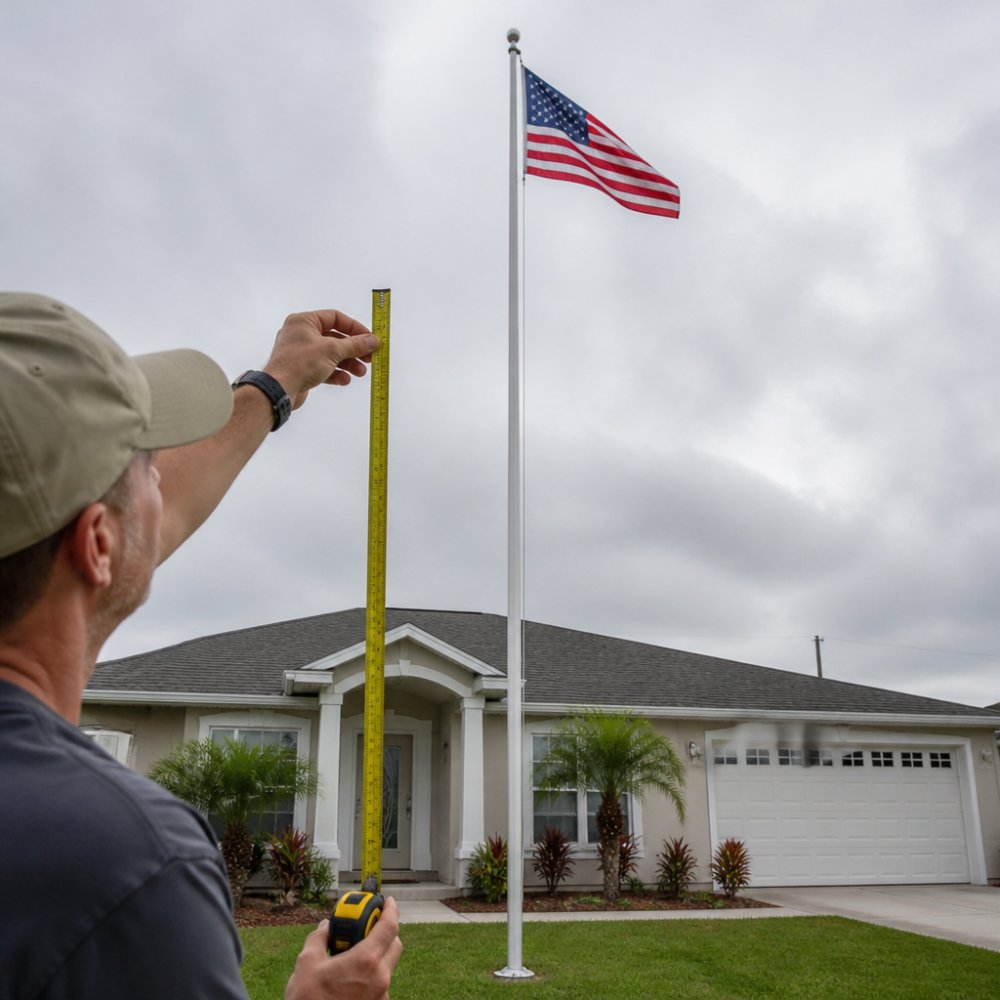
That distinction matters. If your roofline peak is 16 feet, an exposed height near 18 feet puts the pole top about 2 feet above the peak.
Measure three things before you decide:
- Roofline peak height, taken at the point closest to where the pole will stand
- Distance from the proposed pole location to the front of the house
- Distance from the pole to the street or sidewalk
A pole viewed from 40 feet away reads shorter than one viewed from 15 feet. Viewing distance is part of scale, not just pole length.
A Practical Height-by-Home Chart
Use this as a starting point, then adjust for setback and sightlines.
| Home Profile | Roofline Peak | Suggested Pole | Why |
|---|---|---|---|
| Compact ranch, small front yard | 9-12 ft | 16 Ft Classic | Keeps the pole from dominating a short sightline |
| Standard single-story, average lot | 12-16 ft | 16 Ft Classic or 20 Ft Superior 1 | Either reads well; 20 ft adds presence |
| Wide single-story with open frontage | 14-18 ft | 20 Ft Superior 1 | Open sightlines carry the extra height |
| Single-story on a large, exposed lot | 14-18 ft | 20 Ft Superior 1 | Height stays proportionate across a long view |
A common pattern is a pole top landing 2 to 6 feet above the roofline peak. Below that range, the flag can look tucked into the roof. Above it, the pole reads as commercial rather than residential.
Roofline, Setback, and Visual Weight
Roofline shape changes how height reads. A low-slope ranch roof gives the eye a long horizontal line, and a 20-foot pole breaks it cleanly. A steep gable already draws the eye upward, so a 20-foot pole can feel like a competing vertical.
Setback works the same way. A pole set 10 feet from the street reads taller than one set 25 feet back. A short setback with a low roofline favors a 16-foot pole.
Recommended Flag Size for a 20-Foot Flagpole
Flag size matters as much as pole height. Too small looks lost on a tall pole. Too large catches excessive wind and stresses the pole.
The general guideline is one-quarter pole height. For a 20-foot pole, that suggests a 5-foot flag. A 4×6-foot flag is also common and works well on 20-foot poles.
Matching Flag Dimensions to Pole Height
A 3×5-foot flag suits a 15-foot pole. A 4×6-foot flag suits a 20-foot pole. These ratios balance visual appearance with wind performance.
The guide on wind load effects for flagpoles explains how flag size and pole height interact. Larger flags catch more wind.
A 3×5 flag on a 20-foot pole looks undersized. A 5×8 flag on a 20-foot pole catches too much wind. Stick with 4×6 for most 20-foot residential installations.
Wind Load and Flag Material
Flag material affects how your pole handles wind. Nylon flags are durable and fade-resistant. Heavy-duty 210D nylon withstands coastal and high-wind conditions better than lighter fabrics.
Wind load increases with flag size and pole height. A 20-foot pole in open terrain sees stronger gusts than a 15-foot pole in a sheltered spot.
The 20 Ft Superior 1 Telescoping Flagpole Kit includes a 3×5 nylon flag. The 20 Ft Heavy Duty Superior 2 includes a 4×6 flag and a heavier-duty solar light. Both setups are engineered for residential durability.
Where to Place a Flagpole in Front of a House
Placement affects how your pole looks and performs. Too close to the house looks cramped. Too far away loses visual connection.
Residential flagpole placement rules and etiquette covers setback requirements and sight-line considerations specific to residential settings.
Setback Distance and Sight Lines
Most areas require 10 to 25 feet of setback from the street. Some require 5 feet minimum from property lines. Check your local code before installation.
Beyond code, think about sight lines. Place your pole where it's visible from the street and from inside your home.
Avoid placing poles near power lines. Maintain at least 10 feet of clearance. If your pole ever falls, it should not reach power lines or structures.
Ground Clearance and Wind Exposure
Open front yards expose your pole to full wind loads.
20 Ft Superior 1 Telescoping Flagpole Kit →
Ground clearance matters too. Your pole's base needs solid footing. Avoid wet, marshy, or unstable ground. A 20-foot pole requires a sturdy base to stay upright in wind.
Check for underground utilities before digging. Call your local utility locator service. They mark gas, electric, water, and phone lines for free.
Residential Flagpole Installation Basics
Installation is where height becomes a structural question. A 20-foot pole carries more sail area and sees stronger wind at its top than a 16-foot pole. The footing, soil, and sleeve all have to match that load.
This section covers how wind load scales with height, how to size the footing, and how to check local rules before you dig.
How Wind Load Scales With Pole Height and Flag Size
Wind force depends on the flag's area and the pole's height. A 4×6 flag presents 24 square feet of sail; a 3×5 presents 15.
Height compounds it.
That is why flag size and pole gauge belong together. The 20 Ft Superior 1 uses 10-gauge 7000-T8 aluminum with a 2.75-inch base.
Material tensile strength alone is not a wind rating. Treat gauge and base diameter as part of the picture, not the whole answer.
Footing Depth, Soil, and Ground Sleeve
A ground-set pole relies on its footing to resist bending. Learn the proper ground-set installation and footing method before you order.
Both 20-foot kits include a 24-inch aluminum ground sleeve. The Superior 2 adds a galvanized-steel flash collar that sits at grade and keeps soil and water away from the sleeve opening.
Let the concrete cure before raising the pole. A common guideline is 48 hours, and longer in cold weather. Do not skip this step to save a day.
Checking Local Codes, HOAs, and Easements
Height rules vary by municipality. Some towns cap flagpole height outright, some tie the cap to lot size or zoning district, and some require a permit and final inspection.
A practical checklist before you order:
- Call your local building department and ask for the flagpole height limit in your zoning district
- Ask whether a permit is required for a ground-set pole
- Ask about front-yard setback minimums and side-yard setbacks
- Check your plat or deed for utility and drainage easements
- Read your HOA covenants for flagpole height, placement, and approval steps
Easements are easy to miss. A pole placed in a utility easement can be removed at your expense if the utility needs access.
Overhead clearance matters too. Keep the pole and its fall zone well away from power lines and service drops.
Comparing 20-Foot and 16-Foot Options
The choice between a 20-foot and 16-foot pole depends on your home's scale and lot size.
A 16-foot pole suits compact lots and smaller homes. A 20-foot pole suits larger properties with open sightlines.
The 16 Ft Classic Telescoping Flagpole Kit features 11-gauge 7000-T8 aluminum with a 2.4-inch base.
A 16-foot pole is easier to install and maintain, and you can reach the flag without a ladder when it's lowered.
| Feature | 16 Ft Classic | 20 Ft Superior 1 |
|---|---|---|
| Aluminum Gauge | 11-gauge | 10-gauge |
| Base Diameter | 2.4 inches | 2.75 inches |
| Flag Size | 3×5 | 3×5 |
| Solar Light | 266-LED | 266-LED |
| Included Flag | U.S. Nylon | U.S. Nylon |
Choosing Your 20-Foot Flagpole Setup
If a 20-foot pole fits your home's scale, the next step is choosing the right kit.
The 20 Ft Superior 1 Telescoping Flagpole Kit combines a 10-gauge 7000-T8 aluminum pole with a 3×5 flag, 266-LED solar light, stainless-steel flag clips, and a ground sleeve. It's built for everyday residential use.

The 20 Ft Heavy Duty Superior 2 adds a heavier 3.5-inch base and a more powerful 566-LED solar light. It includes a 4×6 flag and a galvanized-steel flash collar for extra durability in coastal and high-wind areas.
Both poles come with a 15-year all-weather warranty on the aluminum. Both are made in the USA.
Measure your roofline. Check your local codes. Look at your lot size.
A 20-foot flagpole can absolutely work for a single-story home. The question is whether it matches your specific property.
Frequently Asked Questions
What is a good height for a flagpole at a single-story house?
A 15-foot or 20-foot residential flagpole works well for single-story homes, depending on lot size and visual proportion. A 15-foot pole offers a more compact appearance on smaller lots, while a 20-foot pole provides greater visibility on larger properties. Check your actual roofline height and setback distance to confirm the fit.
What size flag should I use on a 20-foot flagpole?
A 3×5-foot or 4×6-foot flag works on a 20-foot pole. The flag-to-pole ratio guideline suggests the flag length should be roughly one-quarter of the pole height. A 3×5-foot flag is standard for residential display, while a 4×6-foot flag provides more visual impact on taller poles or in open areas. Wind conditions and flag material affect how the flag flies, so heavier nylon flags perform better in gusty conditions.
Will a 20-foot flagpole look too large beside my home?
A 20-foot pole may appear oversized on a compact lot or beside a single-story home if not positioned correctly. Placement away from the house, proper setback distance, and flag size all influence how the pole appears. Measure your roofline and lot dimensions before deciding; a pole that extends 4-6 feet above the roofline typically looks balanced on a single-story home.
Do I need to check local rules before installing a residential flagpole?
Yes, check local zoning codes and HOA restrictions before installation. Many jurisdictions limit flagpole height, require setback distances, or mandate permits. Contact your local building department to confirm height limits, property line setbacks, and whether a permit is needed. Some areas have specific rules for residential flagpole placement in front yards. Verifying these requirements upfront prevents costly removals or fines.
