

Nautical Telescoping Flagpole: Why Choose One in 2026
Table of Contents
- What Is a Nautical Telescoping Flagpole?
- Telescoping vs. One-Piece Flagpoles: A Side-by-Side Comparison
- Why Coastal Panhandle Properties Need a Nautical Telescoping Flagpole
- 7000 T8 Aluminum Flagpole Benefits: Strength You Can Measure
- Best Residential Flagpoles for Wind: What to Look For
- Installation, Ground Sleeve, and Foundation Specifics
- Locking Mechanisms and Long-Term Maintenance
- Aesthetic Integration and Property Value
- Conclusion
- Frequently Asked Questions
Last Updated: September 23, 2026
What Is a Nautical Telescoping Flagpole?
A nautical telescoping flagpole is a retractable flagpole built with a yardarm-style display and marine-grade hardware, designed so the mast collapses into itself for storage or storm prep. At Armor Flagpoles, we offer these poles, and the category exists for one reason: coastal properties punish equipment that wasn't built for salt and wind.

The defining feature is the yardarm, a horizontal spar mounted on the second section that lets you fly multiple flags in a traditional maritime arrangement. Combined with interlocking telescopic segments, a halyard-free design, and stainless-steel fly attachments, the pole reads as nautical rather than civic.
The maritime yardarm difference
A standard residential flagpole flies one flag from a halyard at the top. A yardarm pole flies several, positioned the way a ship or marina would display them.
That changes both the look and the mechanics. The yardarm sits on the second section, held by rope cleats that come already attached, so the display stays level as the pole extends. For waterfront homeowners who want a dock or seawall presentation rather than a front-lawn flag, the difference is immediately visible.
Telescoping vs. One-Piece Flagpoles: A Side-by-Side Comparison
Telescoping poles win on portability, storm response, and storage; one-piece poles win on simplicity. The trade-off is mechanical: telescoping sections add locking pins and joints that need occasional attention.
Feature |
One-Piece Flagpole |
|
|---|---|---|
Setup |
Slides up by hand, no digging depth for a tall mast |
Requires a deep foundation or crane for tall heights |
Storm prep |
Retracts in minutes |
Must be lowered by halyard or left up |
Storage |
Collapses for RV, garage, or off-season |
Stays planted year-round |
Portability |
Moves between properties |
Fixed installation |
Maintenance |
Locking pins and joints need inspection |
Fewer moving parts |
The retractable design is the deciding factor for anyone in a storm zone. When inclement weather approaches, a telescoping pole comes down without a ladder, which matters more than any spec sheet line.

Why Coastal Panhandle Properties Need a Nautical Telescoping Flagpole
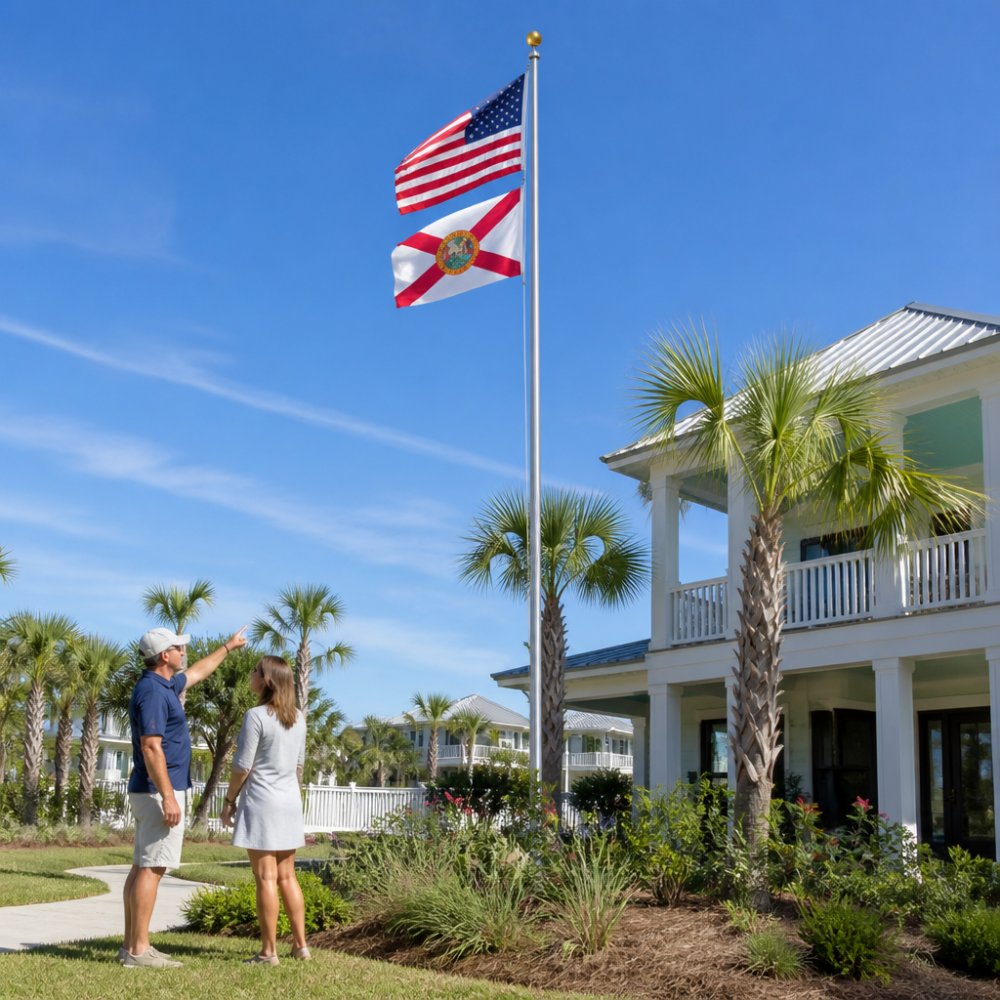
Salt spray and hurricane-season gusts are the two forces that destroy flagpoles on the Panhandle coast. A nautical telescoping flagpole addresses both through material choice and retractability.
Salt spray and corrosion resistance
Corrosion resistance starts with the aluminum alloy and the hardware. Anodized finishes and stainless-steel attachments hold up far better than painted steel or zinc-plated fittings, which pit and flake when coastal air carries salt onto them daily. A pole rated for marine conditions should specify both the alloy and the finish, not just call itself "weather resistant."
Storm preparedness and quick retraction
The telescoping design exists for exactly one scenario: a storm you can see coming.
Five telescoping sections collapse by hand, so lowering the pole before a named storm takes minutes instead of a ladder climb. That single capability is why coastal buyers choose telescoping over one-piece, and it's the reason retractability shows up in nearly every serious guide on the subject.
7000 T8 Aluminum Flagpole Benefits: Strength You Can Measure
The 7000 T8 aluminum flagpole benefits come down to two numbers: alloy series and gauge. 7000-series aluminum is among the strongest alloys used in flagpole construction, and T8 tempering raises its yield strength further.
Gauge matters just as much. A thicker wall resists bending under wind load, and it holds the pole's shape when the sections are fully extended. A 10-gauge wall paired with a 3½-inch base diameter gives the mast real structural integrity instead of a hollow shell that flexes in a gust.
That's the honest answer to "is this just spec-sheet marketing": the alloy and gauge are the two figures that determine whether a pole survives a coastal winter or dents in its first hard blow.
Best Residential Flagpoles for Wind: What to Look For
The best residential flagpoles for wind share four traits: a strong alloy, a thick wall, a wide base, and a way to come down fast. Skip any one and the pole becomes a liability in a gust.
- Wind load rating: look for a stated rating, not a vague "wind resistant" claim
- Base diameter: wider bases spread load and resist bending at the ground line
- Wall thickness: measured in gauge, thicker walls resist flex
- Retractability: a pole you can lower beats a pole you hope holds
Pole diameter and pole stability are linked directly. A 3½-inch base on a tall mast distributes force across more surface area at the foundation, which is where most failures actually begin.
Installation, Ground Sleeve, and Foundation Specifics
A telescoping pole still needs a proper ground sleeve and base foundation. The sleeve is the part most installers rush, and it's the part that decides whether the pole stays plumb. What almost no guide tells you is that the foundation spec changes with your soil, and coastal Panhandle soil is rarely the same from one lot to the next.
20 Ft Superior 2 Nautical Telescoping →
Match the foundation to your soil
The Panhandle coast runs from loose sugar sand near the dunes to heavy clay and muck further inland, and each behaves differently under a tall mast.
- Loose sand: the hole walls collapse inward as you dig, so over-dig the diameter by roughly double the sleeve width and expect to use more concrete to lock the sleeve in place. Sand drains fast, which is good, but it offers almost no lateral grip on its own.
- Clay and muck: these hold water, so the sleeve sits in a bathtub after every heavy rain. A concrete collar at grade is mandatory here, not optional, because saturated clay lets the sleeve creep and the pole lose plumb.
- Fill dirt: common on newer coastal lots and the least predictable. Treat it like loose sand and lean toward a wider, deeper concrete collar.
The correct sequence
- Dig the hole wider than the sleeve, not just deep enough for it, a hole only as wide as the sleeve gives the concrete nothing to grip.
- Set the ground sleeve plumb, then backfill and tamp in layers. Check plumb after every layer, not just at the end.
- Pour a concrete collar around the sleeve at grade. This is the ring that resists the lateral force a tall mast transfers to the ground.
- Let the foundation cure fully before raising the mast. A common pattern is to wait several days in warm, dry weather and longer in humid or rainy stretches, concrete that hasn't cured will shift the moment the pole takes a gust.
- Slide the pole into the sleeve and extend section by section, checking that each locking pin seats before moving to the next.
An extra-thick aluminum ground sleeve, like the 24-inch by 3½-inch sleeve included with our nautical kits, resists the lateral force that a tall mast transfers to the ground during a gust. A thin sleeve deforms, the pole leans, and no amount of tightening fixes a foundation that moved.
Locking Mechanisms and Long-Term Maintenance
Locking mechanisms are where telescoping poles live or die over time. Internal and external locks both work, but they wear differently, and that wear is the part most buyers never think about until a section won't hold.
How the two lock styles actually hold a pole up
- Internal locking pins sit inside the pole, shielded from salt and grit. Each section carries a spring-loaded pin that snaps into a hole in the section above it, so the load is carried by the pin in shear rather than by friction. The upside is protection from the elements; the downside is that you can't see the pin, so a stiff or corroded one gives no warning until a section slips.
- External twist-locks clamp the sections together with a collar you tighten by hand. They're easy to see and service, but the collar collects grit and salt, and a collar that isn't fully tightened lets a section telescope down under wind load.
Either design prevents collapse the same way: the lock has to carry the section's weight plus the wind load pushing against the flag. That's why a pin that's slightly seized or a collar that's a quarter-turn loose matters more than it looks.
A seasonal maintenance schedule
Most practitioners find that a light routine beats a heavy repair every time. A workable schedule:
- After every heavy salt exposure: rinse the pole and joints with fresh water. Salt left on hardware is what starts the pitting.
- Monthly during flag season: work each section up and down a few times so the pins and collars don't take a set.
- Before storm season: inspect every pin and collar for stiffness or corrosion, and confirm each section locks before you trust it in a gust.
- Annually: lubricate moving parts sparingly with a marine-safe product. More lubricant isn't better, excess attracts grit that jams the mechanism.
Troubleshooting the common failures
- A section won't lock: the pin is usually stiff or the hole is packed with grit. Work the section and rinse before forcing it.
- A section slips down under load: on a twist-lock, the collar isn't fully seated; on a pin lock, the pin isn't fully engaged in its hole.
- A section won't retract: corrosion or a bent pin. Don't force it, forcing a seized section is how pins snap.
A common mistake is ignoring the pins until a section slips. By then the pin is usually seized, and freeing it takes far longer than the seasonal check would have.
Aesthetic Integration and Property Value
A flagpole is a permanent piece of a property's curb appeal, so it should look intentional. The yardarm profile, anodized finish, and clean stainless hardware read as a designed maritime feature rather than an afterthought bolted to the lawn.
Placement matters as much as the pole. Setting the base so the mast aligns with a sightline from the street, and letting landscaping soften the foundation, integrates the display into the yard instead of competing with it. A well-placed pole adds to property value the same way any considered exterior feature does, and a leaning, rusted one drags it down.
For coastal and waterfront homes, the nautical style also just fits. A yardarm display suits a dock, marina, or seawall setting in a way a plain civic pole never will.
Conclusion
The hard part isn't deciding you want a flagpole. It's finding one that survives salt air, storm season, and a decade of sun without seizing, rusting, or leaning.
Armor Flagpoles offers the 20 Ft Superior 2 Nautical Telescoping Flagpole Kit and the 25 Ft Superior 2 Nautical Telescoping Flagpole Kit, both built with 10-gauge 7000-T8 aluminum, a 3½-inch base, stainless-steel hardware, a yardarm display, and a 15-year all-weather factory pole warranty. Both include a 24-inch ground sleeve, solar lighting, and a ball-bearing swivel ring system to help prevent flags from tangling.
If you want a nautical telescoping flagpole that's built to hold up on the coast, explore the nautical flagpole collection and get started with Armor Flagpoles.
Frequently Asked Questions
What is the best type of flagpole for residential use?
For most homeowners, a telescoping flagpole is the best residential choice because it combines easy height adjustment, compact storage, and strong wind resistance. Nautical telescoping flagpoles add a yardarm and stainless-steel hardware for a maritime look. If you live near the coast, look for 7000 T8 aluminum construction and a 15-year warranty. Armor Flagpoles offers 20 ft and 25 ft nautical kits built for coastal conditions.
Does a flagpole increase property value?
A well-installed flagpole can boost curb appeal and make a property more memorable, which may support resale value in competitive markets. Real estate agents often note that strong exterior features help homes stand out. A nautical telescoping flagpole with a clean yardarm display and solar lighting adds a polished, patriotic touch that appeals to buyers. However, no flagpole guarantees a specific dollar increase; the impact depends on local demand and how well it integrates with the landscape.
Can a telescoping flagpole withstand salt air and humidity?
Yes, if it is built with marine-grade materials. A nautical telescoping flagpole made from 7000 T8 aluminum with stainless-steel fly attachments and an anodized finish resists corrosion far better than standard aluminum or steel poles. The thick 10-gauge walls and 3.5-inch base add structural integrity. For coastal Panhandle Florida, where salt spray and humidity are constant, this construction helps the pole last for years instead of rusting out in three.
What maintenance is required for a nautical telescoping flagpole?
Maintenance is minimal: rinse the pole with fresh water every few weeks to remove salt and dirt, inspect the locking pins and swivel harness for wear, and lubricate the telescoping sections once or twice a year with a silicone spray. Check the ground sleeve for water pooling and clear any debris. The 15-year factory warranty covers the pole itself, but keeping the locking mechanism clean ensures smooth height adjustment and long-term reliability.