

Portable Flagpole for RV Camping: A 2026 Buyer's Guide
Table of Contents
- Why Portable Flagpoles Matter for RV Camping
- Telescoping Flagpole vs. Sectional Poles for RVs
- Material Comparison: Fiberglass vs. Aluminum for Durability
- RV Flagpole Hitch Mount Options and Installation
- Solar Flagpole Light for RV Nighttime Visibility
- Height Requirements and Rooftop Clearance for Travel Trailers and 5th Wheels
- RV Bumper Hitch Adapter and Compatibility Matrix
- Wind Resistance, Weather Protection, and Maintenance
- Frequently Asked Questions
Last Updated: October 7, 2026
Why Portable Flagpoles Matter for RV Camping
A portable flagpole for RV camping turns your campsite into a patriotic display that stands out at any gathering.
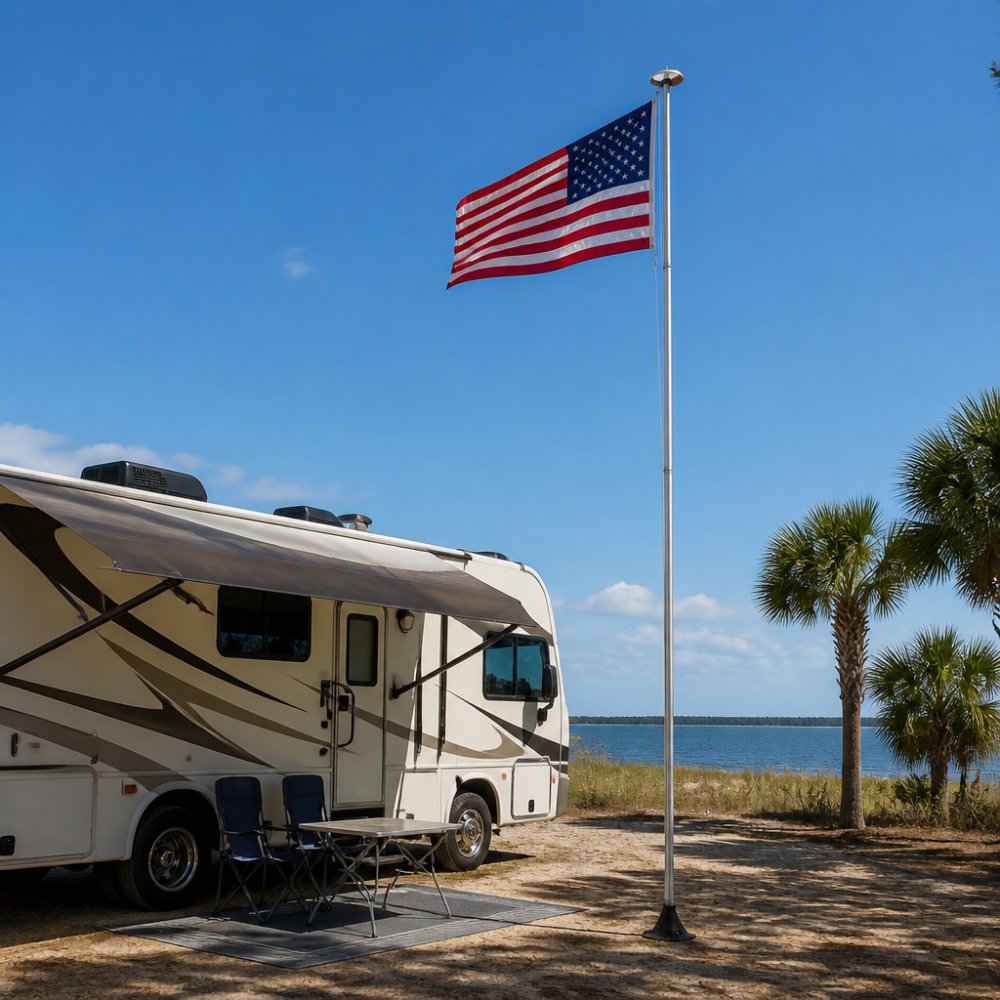
A portable flagpole for rv camping makes your campsite easier to locate in crowded campgrounds, displays patriotic pride at events, and creates a sense of home wherever you travel.
The challenge is choosing the right setup. A flagpole mounted to a ladder rack can cause severe damage to your RV, so it must be secured properly and handle gusts without compromising stability. Because you move frequently, installation and takedown speed also matter.
Telescoping Flagpole vs. Sectional Poles for RVs
Telescoping poles dominate the RV market because they collapse for storage and extend for display. A four- or five-section design lets you lower the pole to change flags without climbing.
The 16 Ft Classic Telescoping Flagpole Kit uses a four-section, 11-gauge 7000-T8 aluminum design. This height works well for travel trailers, giving visibility without the flag dragging across the rooftop, and fewer joints mean faster setup.

For larger fifth wheels and Class A motorhomes, the 20 Ft Superior 1 Telescoping Flagpole Kit offers five sections of 10-gauge 7000-T8 aluminum.
Sectional poles are less common for RV use because they take more time to set up and break down.
Material Comparison: Fiberglass vs. Aluminum for Durability
Aluminum is the standard for RV flagpoles because it resists corrosion better than steel and weighs less than fiberglass, making it easier to handle.
The 7000-T8 aluminum alloy used in Armor Flagpoles products is engineered for salt spray and coastal environments, resisting oxidation far better than standard aluminum.
Gauge thickness tells you how much material is in each section. An 11-gauge pole (like the 16 Ft Classic) has thicker walls than a 12-gauge pole, and a 10-gauge pole (like the 20 Ft Superior 1) is heavier and stronger still. Thicker aluminum resists bending under wind load.

How Wind Load Actually Stresses a Pole
Wind pressure on a flagpole rises with the square of wind speed: doubling wind speed roughly quadruples the bending force at the base. That is why a pole that feels rock-solid in a 10 mph breeze can flex visibly in a 30 mph front.
The flag itself is the largest sail in the system. A 3x5 ft flag presents about 15 square feet of fabric; a 4x6 ft flag presents about 24 square feet, increasing the bending moment at the base by roughly 60 percent.
A pole's resistance to bending comes from wall thickness (gauge) and base diameter. The 20 Ft Superior 1 uses a 2.75-inch base; the 20 Ft Heavy Duty Superior 2 uses a 3.5-inch base.
Fiberglass: Where It Wins and Where It Fails
Fiberglass poles are non-conductive, which appeals to some users in lightning-prone regions, but fiberglass is heavier, more brittle in cold weather, and degrades faster under UV exposure. For RV use, aluminum wins.
Fiberglass earns its place only in a permanent installation with frequent electrical storms. For a pole deployed at a different campsite every few days, the weight penalty and cold-weather brittleness outweigh the conductivity advantage.
Joint Fatigue: The Failure Mode Nobody Talks About
The joints between telescoping sections are where aluminum poles eventually fail, not the tube walls. Every time the pole flexes in wind, the locking collars and section ends absorb concentrated stress, which over hundreds of deploy-and-stow cycles shows up as hairline cracks or sections that no longer lock firmly.
Extend joint life with three habits: seat each section fully so the locking mechanism engages its full contact area; rinse the collars with fresh water after coastal trips, since salt crystals act as an abrasive; and store the pole collapsed and dry.
A pole that wobbles at a joint should not keep flying in gusty conditions. Retire it or replace the affected section before the next trip.
RV Flagpole Hitch Mount Options and Installation
A flagpole mount hitch attaches to your RV's existing hitch receiver. This method uses your vehicle's structural support point and holds the flagpole base securely.
For pull-behind travel trailers, a bumper hitch adapter fits your rear 4-inch bumper. Once installed, slide your flagpole's base into the receiver and secure it with a pin or bolt.
The base diameter of your pole matters. The 16 Ft Classic has a 2.4-inch base, so you need a flag holder designed for that diameter; the 20 Ft Superior 1 has a 2.75-inch base.

Installation takes minutes once you have the right adapter: align the base with the receiver, slide it in, and secure it. No drilling or permanent modifications are needed.
Solar Flagpole Light for RV Nighttime Visibility
A solar flagpole light extends your flag display into the evening, making your campsite visible and patriotic after dark. The 16 ft classic kit includes a 266 LED Solar Light. The light extends out at a 45 degree angle to capture the entire flag when flying.
More LEDs produce brighter light. The 566-LED light on the 20 Ft Heavy Duty Superior 2 produces noticeably brighter output for larger gathering spaces.
Solar lights eliminate extension cords and batteries. The panel sits on top of the pole, charging throughout the day; at night the LEDs underneath illuminate the flag and the area below.
16 Ft Classic Telescoping Flagpole Kit →
The advantage for RV camping is independence from campground power: no 30-amp or 50-amp hookup and no extension cords across the ground. The light works anywhere, whether you're boondocking or at a full-service campground.
Height Requirements and Rooftop Clearance for Travel Trailers and 5th Wheels
Height is the most critical measurement for RV flagpole selection: too tall and it catches on your rooftop or awning, too short and it won't provide adequate visibility.
For travel trailers, a 16 ft flagpole provides visibility without touching the roofline. Most travel trailers have 12 to 13 feet of vertical clearance from ground to rooftop, so a 16 ft pole mounted at bumper level stays clear.
For fifth wheels and Class A motorhomes, a 20 ft pole works better. A 16 ft pole is not a good choice because it will have you dragging the flag across the roof.
Always measure your RV's height from the ground to the highest point on the roof, then subtract the height of your hitch receiver to get the actual clearance available.
RV Bumper Hitch Adapter and Compatibility Matrix
RV Type |
Recommended Pole |
Base Diameter |
Hitch Receiver Size |
|---|---|---|---|
Travel Trailer |
16 Ft Classic |
2.4 inches |
1.25 or 2 inches |
5th Wheel |
20 Ft Superior 1 |
2.75 inches |
1.25 or 2 inches |
Class A Motorhome |
20 Ft Superior 1 or 2 |
2.75 or 3.5 inches |
2 inches |
Standard RV bumpers use either a 1.25-inch or 2-inch receiver opening. Measure before purchasing an adapter: a 1.25-inch receiver requires a 1.25-inch adapter, and a 2-inch receiver requires a 2-inch adapter.
The base diameter of your flagpole determines the flag holder you need. The 16 Ft Classic's 2.4-inch base requires a holder designed for that diameter, and the 20 Ft Superior 1's 2.75-inch base needs a different holder. The correct holder prevents the pole from spinning freely or leaning in wind gusts.
Once you have the correct adapter and holder, installation is straightforward: slide the pole's base into the holder, secure it, and deploy.
Wind Resistance, Weather Protection, and Maintenance
Wind resistance is critical for RV flagpoles. Your pole needs to handle gusts without bending or creating dangerous vibrations that could damage your RV.
Wind Speed Safety Chart
Use this as a practical reference, assuming a standard 3x5 ft flag on a properly seated telescoping pole with a secure hitch mount.
Sustained Wind Speed |
What You'll See |
Recommended Action |
|---|---|---|
0-15 mph |
Flag hangs or ripples gently |
Fly normally |
15-25 mph |
Flag fully extended, pole steady |
Fly normally, check mount hardware |
25-35 mph |
Pole flexes visibly, flag snaps |
Fly with caution, shorten flag if possible |
35-50 mph |
Pole bows noticeably, vibration in mount |
Lower the flag, keep pole up only if you can monitor it |
Over 50 mph |
Pole and mount under heavy stress |
Lower the flagpole completely |
When winds exceed 50 mph, lower your flagpole. This safety precaution prevents excessive stress on the hitch mount and your RV's frame, and lowering takes seconds with a telescoping design.
The 10-gauge aluminum in the 20 Ft Superior 1 and Superior 2 resists bending better than the 11-gauge 16 Ft Classic, and the Superior 2's larger 3.5-inch base (versus 2.75 inches) adds stability.
Weather Protection Between Trips
Stainless-steel flag clips resist corrosion, and a 7000-T8 alloy pole needs no painting or sealing. Rinse the pole with fresh water after coastal trips to remove salt spray, and check the locking mechanism annually.
The ball-bearing swivel at the pole top lets the flag rotate freely, reducing tangling and wear.
Maintenance and Repair: Fixing the Two Most Common Failures
These are the two failures owners actually run into.
Stuck telescoping sections. A section that will not slide usually has grit, salt, or a slightly bent tube. Do not force it: collapse the pole as far as it will go, then twist gently while pulling to free it.
Frayed or stretched halyard rope. The rope that raises the flag wears fastest at the top pulley and cleat. Inspect it each season and replace any rope with visible fraying near the pulley before it snaps mid-display.
Loose or spinning flag clips. Clips that no longer hold the flag taut let it wrap around the pole in wind, accelerating fabric wear and putting uneven load on the pole. Replace worn clips rather than bending them back into shape.
Storage Between Trips
Store the pole collapsed, dry, and inside its carry sleeve or storage bay. Leaving a telescoping pole extended between trips exposes the joints to road vibration and UV, the two conditions that shorten pole life fastest.
Frequently Asked Questions
What is the best height for a portable flagpole for RV camping?
The 16 Ft Classic Telescoping Flagpole works best for travel trailers, ensuring the flag clears the rooftop without risk of dragging on the camper. For 5th wheels with higher profiles, the 20 Ft Superior 1 Telescoping Flagpole provides adequate clearance while remaining portable. Always measure your RV's height and account for roof-mounted equipment before selecting a flagpole height.
How do I mount a flagpole to my RV without causing damage?
Use a flagpole mount hitch that attaches securely to your RV's hitch receiver. Never mount a flagpole to your RV's ladder rack, as this can cause severe damage to the camper structure. Always lower your flagpole when winds exceed 50 mph to protect both the pole and your RV.
Can I use a solar flagpole light for RV camping?
Yes. The 266-LED solar light included with most kits charges during the day and illuminates your flag after dark, providing visible light at ground level for your campground area. This feature enhances safety and visibility around your campsite without requiring electrical hookups. The solar panel sits on top of the pole with LEDs underneath, making it ideal for mobile camping situations.
What mounting options work for pull-behind travel trailers?
Pull-behind trailers can use a bumper hitch adapter to attach a flagpole mount to the rear 4-inch bumper. This method keeps the flagpole clear of the camper's roof and structure. Always verify that the flagpole height clears your trailer's roofline before securing the installation.
How do I know if my flagpole can withstand coastal or high-wind conditions?
Look for poles made from 10-gauge 7000-T8 aluminum with larger base diameters (2.75 inches or more), which offer superior wind resistance and stability. The 20 Ft Superior 1 and 20 Ft Heavy Duty Superior 2 are engineered for durability in harsh weather. Both feature corrosion-resistant aluminum construction and come with a 15-year warranty. Lower your flagpole when winds exceed 50 mph to prevent damage.