

Residential Flagpoles Built to Withstand Storm-Force Winds
Table of Contents
- Quick Comparison: Heavy-Duty Telescoping Flagpole Wind Rating at a Glance
- What Makes a Residential Flagpole Survive Storm-Force Winds?
- 7000 T8 Aluminum Flagpole Durability: Why Alloy Grade Beats Marketing Claims
- Residential Flagpole Installation Best Practices for High-Wind Areas
- 1. 30 Ft Heavy Duty Superior 2 Telescoping Flagpole Kit: Maximum Height, Maximum Wind Resistance
- 2. 25 Ft Heavy Duty Superior 2 Telescoping Flagpole Kit: The Everyday Workhorse
- 3. 25 Ft Superior 2 Nautical Telescoping Flagpole Kit: Built for Salt Spray and Coastal Gusts
- 4. 20 Ft Heavy Duty Superior 2 Telescoping Flagpole Kit: Compact Strength for Smaller Yards
- How Do You Choose Between These Four Poles?
- Frequently Asked Questions
Last Updated: September 30, 2026
Quick Comparison: Heavy-Duty Telescoping Flagpole Wind Rating at a Glance
Storm-force winds find the weakest point and exploit it. Survival comes down to three specs: alloy grade, wall thickness, and butt diameter. This guide compares four heavy-duty telescoping kits.
| Model | Height | Base Diameter | Material | Best For |
|---|---|---|---|---|
| 30 Ft Heavy Duty Superior 2 | 30 ft | 3½ in | 10-gauge 7000-T8 | Maximum height and wind resistance |
| 25 Ft Heavy Duty Superior 2 | 25 ft | 3½ in | 10-gauge 7000-T8 | Everyday residential use |
| 25 Ft Superior 2 Nautical | 25 ft | 3½ in | 10-gauge 7000-T8 | Coastal salt spray |
| 20 Ft Heavy Duty Superior 2 | 20 ft | 3½ in | 10-gauge 7000-T8 | Smaller yards |
Every pole shares the same base diameter and wall thickness, because those matter more than height when storm-force winds hit.

What Makes a Residential Flagpole Survive Storm-Force Winds?
A flagpole survives storm-force winds when its base diameter, wall thickness, and alloy grade are matched to the flag's surface area. Wind creates a bending moment at the base that grows with pole height and flag size; too thin a base fatigues, too thin a wall dents under gusts.
Wind Load, Bending Moment, and Why Butt Diameter Matters
Wind load is the total force the wind exerts on the pole and flag, scaling roughly with the square of wind speed. Double the wind speed and you roughly quadruple the force, a pole fine at 30 mph can be in real trouble at 60 mph.
Bending moment is the rotational force at the base: wind load multiplied by the height at which it acts.
Wall Thickness and Structural Integrity Under Gust Resistance
Wall thickness determines how much shear stress the aluminum absorbs before deforming. A 10-gauge wall resists the dynamic load spikes during gusts where most cheap poles fail.
Sizing the Flag to the Pole: The Rule Most Buyers Get Wrong
Armor Flagpoles uses 10-gauge 7000-T8 aluminum across its heavy-duty line, and every kit carries a 15-year factory pole warranty. That warranty length is a useful signal: a manufacturer doesn't back a pole for 15 years if the alloy can't handle repeated wind load cycles.
7000 T8 Aluminum Flagpole Durability: Why Alloy Grade Beats Marketing Claims
7000 T8 aluminum is a high-strength alloy tempered to its T8 condition, giving it greater tensile strength than the 6000-series aluminum used in most budget flagpoles. A pole made from weaker alloy can look identical on a showroom floor and still bend the first time sustained wind speed crosses into storm territory.
Residential Flagpole Installation Best Practices for High-Wind Areas
A flagpole is a cantilever: every pound of wind force becomes a rotational pull at the base, resisted only by the soil and concrete around the ground sleeve. Most pole failures after a named storm are footings that rotated, heaved, or cracked, not snapped masts. Installation is half the wind rating.
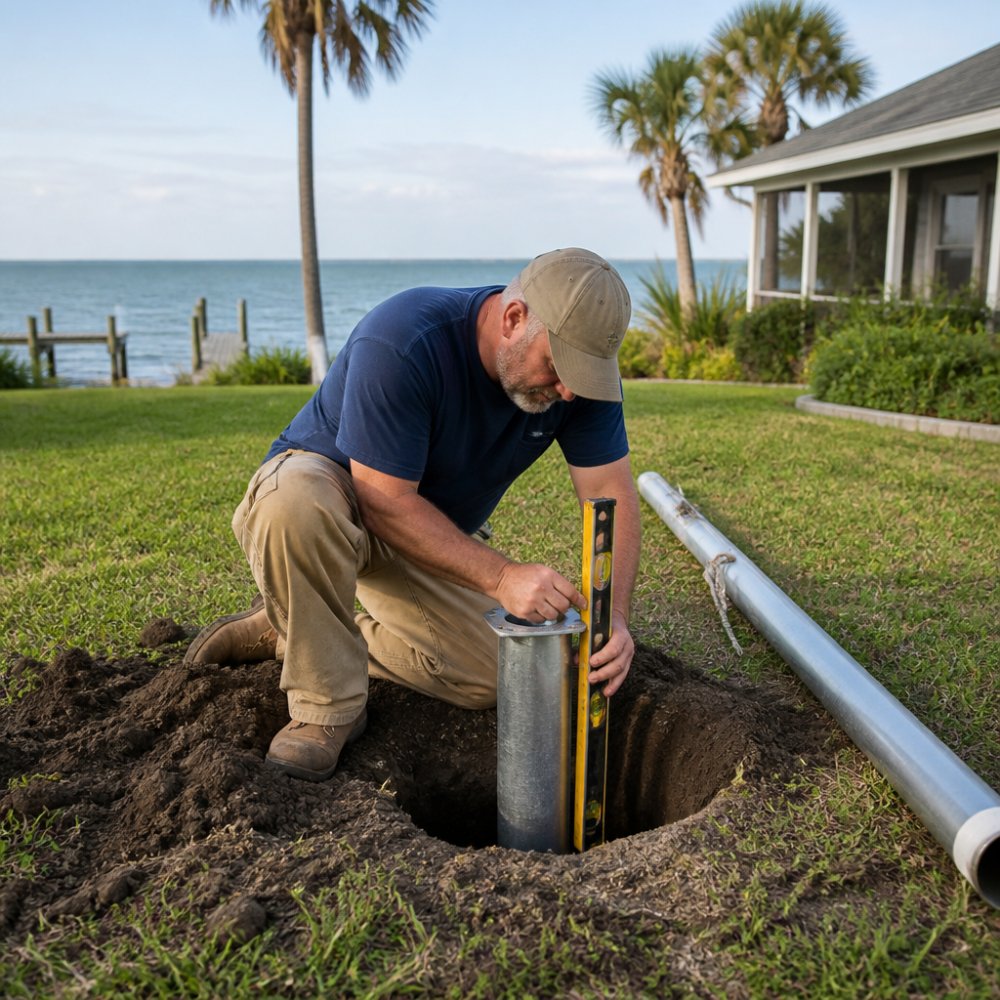
Ground Sleeve Depth, Concrete Footing, and Soil Conditions
Three variables control whether the footing holds: sleeve depth, concrete volume, and soil behavior when saturated.
Why the Footing Is the Real Wind Rating
A pole rated for a given wind speed is rated on the assumption that its base is rigid. If the footing rotates even a few degrees under gust load, the pole works at an angle it was never designed for and the effective wind rating drops. Treat the footing as a structural component with its own spec.
30 Ft Heavy Duty Superior 2 Telescoping →
1. 30 Ft Heavy Duty Superior 2 Telescoping Flagpole Kit: Maximum Height, Maximum Wind Resistance
The 30-foot Superior 2 is the tallest pole in this lineup, for maximum height without giving up structural integrity. It runs a 3½-inch base, five telescoping sections, and 10-gauge 7000-T8 aluminum, so the extra height doesn't cost you a thinner wall.

2. 25 Ft Heavy Duty Superior 2 Telescoping Flagpole Kit: The Everyday Workhorse
For most homeowners, 25 feet is the sweet spot. This kit carries the same 10-gauge 7000-T8 aluminum, 3½-inch base, and five-section telescoping design as the 30-foot model, at a height that fits a standard residential lot.
3. 25 Ft Superior 2 Nautical Telescoping Flagpole Kit: Built for Salt Spray and Coastal Gusts
Coastal properties punish flagpoles differently: salt spray attacks hardware and finishes, and waterfront gusts arrive with less obstruction to slow them. This nautical kit answers both with the same 10-gauge 7000-T8 mast and 3½-inch base, plus a 24-inch × 3½-inch extra-thick aluminum ground sleeve for a more substantial footing.
4. 20 Ft Heavy Duty Superior 2 Telescoping Flagpole Kit: Compact Strength for Smaller Yards
Not every yard needs 30 feet of mast. The 20-foot Superior 2 keeps the full-strength build, 10-gauge 7000-T8 aluminum, 3½-inch base, five telescoping sections, in a footprint that suits smaller lots, tight setbacks, and RV-adjacent setups.

How Do You Choose Between These Four Poles?
Match the pole to your space first, then to your display plans. A 30-foot pole in a small yard looks out of proportion and puts more flag surface area into the wind than the site needs; a 20-foot pole on a large waterfront lot may lack presence.
- Largest yard, maximum display: 30 Ft Heavy Duty Superior 2
- Standard residential lot: 25 Ft Heavy Duty Superior 2
- Coastal or waterfront property: 25 Ft Superior 2 Nautical
- Smaller yard or mobile setup: 20 Ft Heavy Duty Superior 2
Frequently Asked Questions
What wind speed rating should I look for in a residential flagpole?
Look for a pole rated for sustained wind speeds of at least 100 mph, with gust resistance tested higher. The rating should come from the manufacturer and reflect the pole's full assembly, not just the aluminum tube. A heavy-duty telescoping flagpole wind rating depends on butt diameter, wall thickness, and section count working together. Ask for the specific test standard the manufacturer used, and confirm whether the rating assumes the pole is fully extended or partially retracted.
Are telescoping flagpoles strong enough for hurricane-prone areas?
Yes, when the pole is built from the right material and gauge. A telescoping design with five sections, a 3½-inch base, and 10-gauge 7000-T8 aluminum provides the bending resistance needed in storm-force winds. The telescoping feature also lets you lower the pole before a named storm arrives, which reduces flag surface area and drag coefficient. Check the manufacturer's warranty terms for wind damage coverage, since not all warranties include storm events.
How does aluminum gauge thickness affect flagpole durability?
Gauge thickness determines how much bending moment and shear stress the pole can absorb before deforming. A 10-gauge wall is substantially thicker than the 16- or 18-gauge aluminum used in budget flagpoles, which means it resists permanent bending under sustained wind load. Thicker walls also hold up better against corrosion over time because there is more material to lose before structural integrity is compromised. When comparing flagpoles, gauge thickness is one of the few specs that directly predicts how the pole will perform in a storm.
Do I need professional installation for a high-wind rated flagpole?
Most residential telescoping flagpoles are designed for homeowner installation using a ground sleeve and concrete footing. You will need to dig to the depth specified by the manufacturer, typically 24 inches or more depending on pole height and soil type. Sandy or loose soil may require a wider footing or additional reinforcement. If you are installing near a seawall, dock, or on a slope, consult a contractor familiar with local foundation requirements before you dig.
What is the best flag material for high winds?
Nylon flags, specifically 210D nylon, offer the best balance of durability and wind performance for residential use. Nylon sheds wind better than cotton or polyester because it has some natural give, which reduces the shock load on the pole during gusts. Heavier fabrics last longer in constant wind but transfer more force to the pole. A 4x6 nylon flag paired with a swivel harness and ball-bearing rings will tangle less and put less stress on the truck assembly during storm-force winds.
Storm-force winds expose every shortcut in a flagpole's design, and most residential poles fail at the base or the wall, not the top. Armor Flagpoles builds its heavy-duty line around 10-gauge 7000-T8 aluminum, a 3½-inch base, and a 15-year factory pole warranty, so the specs hold up when the weather doesn't. If you're ready to stop replacing bent poles every few seasons, get started with Armor Flagpoles and choose the height that fits your yard.