

What Is 10 Gauge Aluminum Strength? 7 Facts That Matter
Last Updated: November 14, 2026
Quick Summary
10 gauge aluminum measures roughly 0.10 to 0.14 inches thick, but thickness alone does not set its strength. Alloy and temper decide how much load the sheet carries, so two 10 gauge panels can perform very differently.
- Higher gauge numbers mean thinner metal, so 10 gauge is thicker than 16 gauge.
- A 10 gauge sheet of carbon steel is thicker than a 10 gauge sheet of aluminum.
- T8 temper means the alloy was solution heat-treated, cold-worked, then artificially aged.
- A 10 gauge panel needs a larger bending radius than thin sheet to avoid cracking.
- 10 gauge is often a special order size while suppliers stock 12 and 14 gauge.
Table of Contents
- Why 10 Gauge Aluminum Strength Confuses Most Buyers
- 10 Gauge Aluminum Thickness in Inches and Millimeters
- The Tensile Strength of 7000 Series Aluminum Explained
- How Alloy, Temper, and Gauge Work Together
- Where 10 Gauge Aluminum Earns Its Keep Outdoors
- What 10 Gauge Aluminum Means for a Flagpole
- Match the Pole to Your Setup Before You Buy
- Frequently Asked Questions
Why 10 Gauge Aluminum Strength Confuses Most Buyers
The question "what is 10 gauge aluminum strength" trips up buyers because gauge charts only tell you thickness, not strength. At Armor Flagpoles, we see this confusion constantly. A shopper reads "10 gauge" on a spec sheet and assumes it means a fixed strength level. It doesn't.
Gauge is a thickness reference, nothing more. The Metal Supermarkets sheet metal gauge chart lists 10-gauge aluminum at 0.1019 inches, or 2.588 mm. A separate C. Metals gauge reference lists it at 0.1406 inches and 5.851 lb/ft². Two charts, two numbers, same gauge label.
That gap is the whole story. Gauge standards vary by material and by chart, and thickness alone never establishes how much load a piece of aluminum will carry. Alloy and temper decide that.
Below, we break down what 10 gauge aluminum actually measures, why 7000 series alloy changes the math, and how those facts apply to a real flagpole. If you want the short version on strength and thickness first, our guide on whether 10 gauge aluminum is strong answers it directly.
10 Gauge Aluminum Thickness in Inches and Millimeters
10 gauge aluminum measures roughly 0.10 to 0.14 inches thick, depending on which standard the supplier uses. In metric terms, that lands between 2.59 mm and 3.57 mm. Always confirm the decimal equivalent on the supplier's own chart before you specify a sheet.
Why Gauge Numbers Run in Reverse
Higher gauge numbers mean thinner metal. That's the opposite of how most people read numbers, and it catches buyers off guard. A 10 gauge sheet is thicker than a 16 gauge sheet, not thinner.
The gauge system descends from old wire-drawing standards, where each pass through a die thinned the material and raised the count. The convention stuck. So when you compare a 10 gauge panel to a 22 gauge panel, you're comparing heavy stock to light stock.
Aluminum Versus Steel Gauge Standards
The same gauge number does not mean the same thickness across metals. A 10 gauge sheet of carbon steel is thicker than a 10 gauge sheet of aluminum. Stainless steel and galvanized stock follow their own curves too.
This matters when you cross-reference a material specification written for steel against an aluminum part. Pull the decimal equivalent and the millimeter figure from an aluminum-specific chart. Don't carry a steel number over.
| Gauge | Aluminum Thickness (in) | Aluminum Thickness (mm) | Relative Weight |
|---|---|---|---|
| 10 | 0.1019 - 0.1406 | 2.59 - 3.57 | Heaviest common sheet |
| 12 | ~0.0808 | ~2.05 | Heavy |
| 14 | ~0.0641 | ~1.63 | Medium |
| 16 | ~0.0508 | ~1.29 | Light |
| 18 | ~0.0403 | ~1.02 | Very light |
Values are reference figures from published gauge charts; confirm against your supplier's chart.
The Tensile Strength of 7000 Series Aluminum Explained
Tensile strength of 7000 series aluminum is high because zinc is the primary alloying element, and that family responds strongly to heat treatment. The alloy grade carries more of the strength story than the gauge number does. Two panels at 10 gauge can behave very differently if one is 6061 and the other is a 7000 series alloy.
That is the gap most gauge charts never close. A chart tells you a sheet is 0.1019 inches thick. It says nothing about how much stress that sheet carries before it yields or tears. For anyone specifying 10 gauge aluminum for a load-bearing part, the alloy and temper line on the spec sheet matters more than the gauge line.
Yield Strength Versus Tensile Strength
Yield strength is the stress at which metal stops springing back and starts bending permanently. Tensile strength is the point where it actually tears apart. They are different numbers, and buyers mix them up constantly.
A pole can survive a gust below its yield point and return to shape. Push past yield and the section stays bent. Tensile strength sits higher up the curve, and it is the figure marketing sheets love to quote. Ask which one a spec refers to before you compare two poles.
Yield and tensile figures vary by alloy and product form, so pull them from the mill certificate or supplier datasheet for the specific grade you are buying.
What the T8 Temper Adds
T8 temper means the alloy was solution heat-treated, cold-worked, then artificially aged. That sequence raises strength over a basic T6 or an un-tempered grade. For a telescoping pole, temper is what keeps a thin wall from denting under load.
If you want the head-to-head detail, our breakdown of 7000 T8 aluminum versus standard aluminum walks through the difference. The deeper case for the alloy is covered in our guide to the benefits of 7000 series aluminum for flagpoles.
How Alloy, Temper, and Gauge Work Together
Strength comes from three inputs working as a system: alloy chemistry, temper, and gauge. Change one and the mechanical properties shift. A thick panel of a weak alloy can underperform a thinner panel of a strong, properly tempered one.
Research keeps confirming that composition and processing drive behavior. A 2025 study in Metals on friction stir welding of alloys 1050 and 5754 examined how processing affects thin aluminum sheet. Work published in the Journal of Applied Physics on shocked aluminum looked at mechanical response under extreme load.
The practical takeaway: a spec sheet that lists only gauge is incomplete. Look for alloy and temper alongside it. That combination is what tells you how the part will hold up.
Where 10 Gauge Aluminum Earns Its Keep Outdoors
Heavy-gauge aluminum shows up where parts take repeated load and weather: marine hardware, truck bodies, structural brackets, and heavy-duty outdoor equipment. The thickness resists denting and holds shape under vibration. What most gauge charts skip is why 10 gauge gets chosen over 12 or 14 gauge in those spots, and where the thickness starts to work against you.
Weight-to-Strength Ratio in Practice
The practical comparison is against thinner aluminum, not just steel. Moving from 14 gauge to 10 gauge adds wall thickness and stiffness, and it adds weight per square foot at the same time. A 10 gauge sheet weighs noticeably more per square foot than a 14 gauge sheet of the same alloy. That is the trade a designer makes: more dent resistance and rigidity in exchange for extra mass and a higher material cost per sheet.
For a fixed structure, the extra weight is usually easy to absorb. For a part that gets carried, raised, or mounted on a moving vehicle, the added mass matters. That is why 10 gauge tends to land on brackets, base plates, and load-bearing panels rather than on large cosmetic skins.
Bending and Forming Limits
Thicker sheet resists bending, which is good for rigidity and harder for fabrication. A 10 gauge panel needs a larger bending radius than thin sheet, and tight corners can crack if the temper is already hard. Plan forming around the temper, not against it.
Most practitioners find that the minimum bend radius for a given alloy scales with thickness, so a 10 gauge sheet needs a wider radius than the same alloy at 16 gauge. The exact radius depends on alloy and temper, and the mill datasheet is the place to confirm it. Bending across the grain versus with the grain also changes the result, and a brake operator who ignores that distinction is asking for a cracked flange.
Watch out: specifying a tight bend radius on T8 temper stock without checking the alloy's forming limits is a common way to scrap a batch. If the design needs a sharp corner, a softer temper or a thinner gauge may be the better call.
Availability and Supply Reality
10 gauge is often a skipped size in standard sheet inventory. Many suppliers stock 12 and 14 gauge as everyday items and treat 10 gauge as a special order. That affects lead time and minimum quantity, so confirm availability before you build a schedule around it. Ordering early is cheaper than redesigning late.
What 10 Gauge Aluminum Means for a Flagpole
For a flagpole, 10 gauge aluminum means a wall thick enough to resist denting and hold its shape in steady wind. It does not, by itself, tell you the pole's wind rating. That figure depends on alloy, temper, base diameter, and mounting.
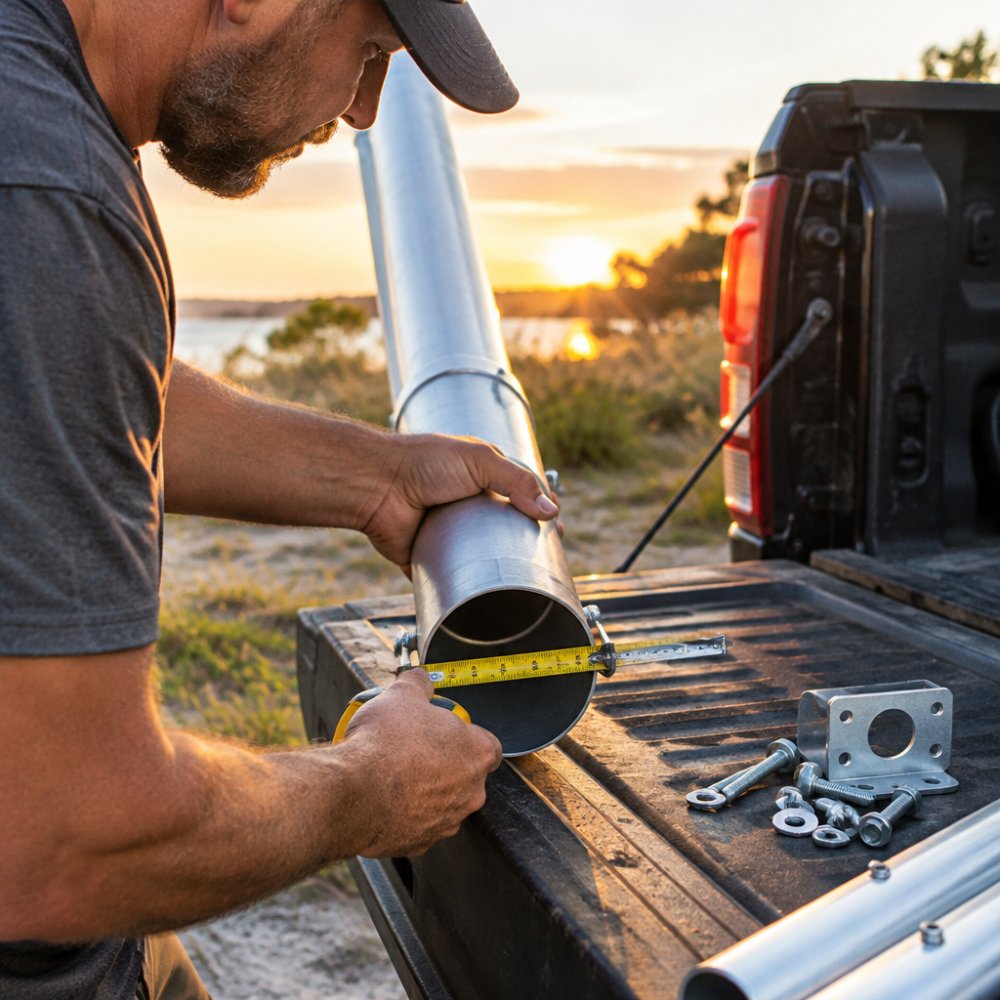
Material tensile strength is not a complete wind rating. The base diameter and the mount also carry the load. Check fit before you buy: the 16 Ft Classic has a 2.4-inch base diameter, and the 20 Ft Superior 1 has a 2.75-inch base diameter.
If you want to see how the material translates into a finished kit, the 30 Ft Superior 2 nautical telescoping flagpole kit shows the full setup with its included flag and solar light.

Match the Pole to Your Setup Before You Buy
Picking a pole is a fit problem before it's a strength problem. Wind load, mounting point, and roof clearance decide which pole works, not the gauge number alone.
- Measure your mount point. Confirm the hitch-mount opening matches the pole's base diameter.
- Check roof clearance. Taller RVs and fifth wheels usually need the 20-foot Superior 1 for flag clearance.
- Match pole to camper height. Lower campers typically use the 16-foot pole.
- Look for drainage. An open bottom and a bottom stop bolt let water escape instead of pooling.
- Confirm the adjustment screw. It takes up slack and keeps the pole seated.
Never mount a pole to a ladder rack or RV ladder. We've seen ladder racks torn up and campers damaged. A hitch mount is the safer path, and you should always verify actual roof clearance before you commit. Our guide on how wind load affects flagpole height requirements explains the sizing logic.
Buying on gauge alone is how people end up with a pole that dents, sticks, or fails to clear the roof. Armor Flagpoles builds telescoping poles from 7000 T8 aluminum at 10 gauge, with a 15 year warranty and hardware we select to match each pole. Check your base diameter and roof clearance first, then pick the pole that fits your setup.
Frequently Asked Questions
What thickness is 10 gauge aluminum?
Published gauge charts list 10 gauge aluminum at 0.1019 inch, or about 2.588 millimeters. Some supplier charts show a different decimal equivalent, so always confirm the figure on the chart your supplier uses. Thickness alone does not tell you how strong the sheet is. Alloy and temper decide how the metal behaves under load, which is why a specification sheet should list all three.
What gauge aluminum is strongest?
No gauge number is strongest on its own. A thicker sheet of a soft alloy can bend where a thinner sheet of 7000 series aluminum holds its shape. Armor Flagpoles uses 10 gauge 7000 T8 aluminum because the alloy, temper, and thickness work together. Ask for the alloy and temper before you compare gauge numbers between two poles.
Is 10 gauge aluminum considered heavy-duty?
At roughly 0.10 inch thick, 10 gauge aluminum sits well above the thin sheet used in light-duty products. Whether it counts as heavy-duty depends on the alloy and temper behind it. A 10 gauge pole in 7000 T8 aluminum gives you real material thickness plus high tensile strength. That combination is what supports a flag in steady coastal wind.
Does aluminum gauge affect structural integrity?
Gauge affects structural integrity, but it is one variable among several. Thicker material resists denting and bending better than thin sheet. Alloy and temper set how much load the metal carries before it deforms. For a flagpole, base diameter and section count also matter. Armor Flagpoles publishes base diameters of 2.4 inches on the 16 Ft Classic and 2.75 inches on the 20 Ft Superior 1.
