

Durable Flagpole for Coastal Homes: Ultimate Guide
Table of Contents
- Why Coastal Homes Demand Durable Flagpoles
- Best Flagpole Material for Coastal Homes
- Salt-Air Corrosion Resistance and Longevity
- Best Residential Flagpoles for Wind
- Matching Flagpole Height and Flag Size to Coastal Conditions
- Telescoping Design for Coastal Installations
- Installation and Foundation for Coastal Soil
- Residential Flagpole Maintenance for Coastal Environments
- Total Cost of Ownership and Warranty Protection
- Choosing the Right Coastal Flagpole for Your Home
- Frequently Asked Questions
Last Updated: October 11, 2026
Why Coastal Homes Demand Durable Flagpoles
Coastal properties face relentless environmental pressures that standard flagpoles simply cannot withstand. Salt spray, sustained wind gusts, humidity, and temperature swings work together to degrade inferior materials at an accelerated rate.
Armor Flagpoles offers solutions specifically for these harsh conditions. The difference between a pole that lasts three years and one that lasts fifteen comes down to material selection, construction thickness, and hardware grade.

The real cost isn't just the pole itself, it's the repeated replacements, the labor to install and remove them, and the missed opportunities to display your flag proudly.
Best Flagpole Material for Coastal Homes
Material choice is the single most important decision when selecting a durable flagpole for coastal homes. Not all aluminum is equal, and the difference between standard aluminum and marine-grade alloys determines whether your pole corrodes within five years or lasts a decade and a half.
7000 T8 Aluminum vs. Standard Aluminum
The 7000 series aluminum alloy, specifically 7000 T8 temper, offers maximum strength and corrosion resistance in harsh environments. This alloy contains zinc, which creates a natural barrier against salt-air oxidation.
Armor Flagpoles uses 10-gauge 7000 T8 aluminum across our residential flagpole lineup. The 10-gauge thickness, roughly 3.4mm, provides structural rigidity that prevents flexing and cracking under high wind loads.
The difference becomes visible within the first year. A 7000 T8 pole maintains its finish and structural integrity. Standard aluminum begins showing surface oxidation and pitting, especially at connection points where salt accumulates.
Fiberglass vs. Aluminum for Salt Air
Fiberglass flagpoles offer non-conductive construction and do not rust in the traditional sense. However, fiberglass degrades differently than aluminum. UV exposure breaks down the resin matrix, causing the fiberglass to become brittle and prone to cracking.
Aluminum, when properly alloyed and maintained, actually becomes more resistant to corrosion over time as a protective oxide layer forms. This natural passivation process doesn't occur with fiberglass.
For coastal homes where you want to lower the pole for maintenance and flag changes, aluminum is the superior choice. The 7000 T8 series specifically offers the strength-to-weight ratio and salt-air resistance that fiberglass cannot match.
Salt-Air Corrosion Resistance and Longevity
Salt spray is the primary enemy of flagpole longevity in coastal environments.
The solution is material selection combined with hardware grade. A durable flagpole for coastal homes requires stainless-steel fasteners, not galvanized or plated steel.
Armor Flagpoles specifies stainless-steel fly attachments, cleats, and fasteners on all coastal-rated models. The 7000 T8 aluminum body combined with stainless hardware creates a system where neither component accelerates the corrosion of the other.
Pole longevity also depends on finish. A quality anodized or powder-coat finish provides an additional barrier against salt spray.
Best Residential Flagpoles for Wind
Wind resistance is the second critical factor for coastal flagpoles. Sustained gusts and storm-force winds place enormous stress on the pole structure. A pole that resists wind damage must combine material strength with intelligent design, specifically, the ability to flex slightly under load rather than resist rigidly and snap.
Pole Strength and Flexibility Under Load
The best residential flagpoles for wind balance two opposing qualities: sufficient stiffness to hold the flag upright, and enough flexibility to absorb gusts without cracking. This balance is achieved through wall thickness and alloy selection.
A 10-gauge 7000 T8 aluminum pole provides the optimal stiffness-to-flexibility ratio. The material's inherent strength allows thinner walls than standard aluminum without sacrificing rigidity.
Hollow aluminum construction also plays a role. A solid pole would be heavier and more brittle.
The telescoping design of Armor Flagpoles' Superior 2 series adds another advantage: you can lower the pole during high-wind events or severe weather.
Height, Base Diameter, and Wind Rating
Wind resistance scales with pole height and flag size. A 20-foot pole flying a 4×6 flag experiences different wind loads than a 30-foot pole with the same flag.
Armor Flagpoles offers models with specific wind ratings. The 20-foot Superior 2 (10-gauge 7000 T8 aluminum, 3.5-inch base diameter) is rated for sustained winds up to 50 mph with gusts to 75 mph.
The base diameter is critical. A 3.5-inch base provides sufficient anchor area to resist the bending moment created by a tall pole in wind.
Pole Height |
Base Diameter |
Typical Wind Rating |
Best For |
|---|---|---|---|
20 ft |
3.5 in |
50-75 mph |
Standard coastal homes |
25 ft |
3.5 in |
50-75 mph |
Larger properties, better visibility |
30 ft |
3.5 in |
50-75 mph |
Waterfront estates, maximum presence |
Matching Flagpole Height and Flag Size to Coastal Conditions
Proportionality matters. A flagpole that looks impressive in calm conditions can become unstable if the flag is too large relative to the pole's structural capacity. Coastal winds demand conservative sizing.
For a 20-foot pole, a 4×6 flag (standard residential size) is appropriate. This size maintains visual balance and stays within the pole's wind rating.
A 25-foot pole can comfortably fly a 4×6 flag with room for a second flag on a yardarm.
The nautical models from Armor Flagpoles, the 20-foot, 25-foot, and 30-foot Superior 2 Nautical kits, are specifically designed with yardarms that distribute wind load across multiple flags rather than concentrating all force on a single pole-mounted flag.

Telescoping Design for Coastal Installations
The telescoping mechanism is a practical advantage that becomes essential in coastal environments. Lowering the pole for flag changes, maintenance, and storm preparation eliminates the need for ladders, extension poles, or professional service calls.
Armor Flagpoles' Superior 2 series features five telescoping sections that extend smoothly and lock securely at full height.
The ground sleeve anchors the base section, creating a stable foundation. A 24-inch aluminum ground sleeve (for 20-foot and 25-foot models) or custom 30-inch sleeve (for 30-foot models) provides sufficient depth for ground-based installation.
Telescoping design also simplifies seasonal maintenance. In fall, you can lower the pole, inspect all sections, clean salt residue, and apply protective finish before winter storms arrive.
Installation and Foundation for Coastal Soil
Coastal soil presents unique installation challenges that differ fundamentally from inland conditions. Salt-laden groundwater, high water tables, sandy substrates, and freeze-thaw cycles in northern coastal regions all demand a foundation strategy tailored to your specific site. A poorly anchored pole will shift, lean, or fail catastrophically during storm events, and coastal soil makes this risk higher than anywhere else.
Soil Assessment and Footing Depth
Before installation, determine your soil type.
Sandy soil has poor load-bearing capacity and drains rapidly. A standard 24-inch ground sleeve depth is often insufficient. Dig to 36 inches or deeper, until you reach more compacted sand or clay.
Clay and silt soils retain moisture and can expand or contract seasonally. These soils are more stable than sand but are prone to frost heave in northern coastal regions where winter temperatures drop below freezing.
Rocky or compacted soil on elevated coastal properties offers excellent load-bearing capacity but is difficult to excavate. A 24-inch depth is usually sufficient if you can reach stable ground.
Concrete Specification for Salt-Water Exposure
Standard concrete deteriorates rapidly in coastal environments. Saltwater penetrates conventional concrete, corrodes the steel reinforcement inside, and causes spalling (surface flaking) within 5-10 years. Specify concrete designed for marine exposure.
Request concrete with a water-to-cement ratio of 0.40 or lower (lower ratios create denser concrete that resists salt penetration).
The concrete should be at least 4 inches thick around the ground sleeve and extend 12 inches above grade. This above-grade collar prevents salt spray from being driven directly into the soil around the sleeve base.
Drainage and Water Management
Water pooling around the base of the pole accelerates corrosion and foundation failure. After installation, slope the ground away from the pole base at a minimum 2 percent grade (roughly 1 inch of drop per 4 feet of distance).
In low-lying coastal properties where the water table is high or flooding is possible, consider installing a drainage system around the pole base.
If your property is in a flood zone, consult your local building department about elevation requirements. Some jurisdictions require that pole foundations be installed above the base flood elevation.
Hardware and Fastener Selection
The bolts, washers, and nuts that secure the pole base to the ground sleeve must be stainless steel, not galvanized or plated steel. Galvanized fasteners fail within 3-5 years in coastal salt spray; stainless steel resists corrosion indefinitely.
Use stainless-steel washers under bolt heads and nuts to distribute load and prevent fasteners from pulling through aluminum. Apply a thin coat of marine-grade anti-seize compound to bolt threads before installation.
Inspect fasteners annually. If any show pitting or discoloration, replace them immediately. Corroded stainless fasteners can fail suddenly under wind load.
Wall-Mounted Installations as an Alternative
For coastal properties with poor soil conditions, limited space, or shallow bedrock, a wall-mounted installation eliminates the need for ground excavation.
Before proceeding, have a structural engineer or experienced contractor verify that your wall can support the wind load. A 25-foot pole flying a 4×6 flag creates a bending moment of approximately 1,500-2,000 foot-pounds at the wall attachment point during a 50 mph wind gust.
20 Ft Superior 2 Nautical Telescoping Flagpole Kit →
Wall-mounted poles are typically installed 8-12 feet above grade, which reduces the moment arm and makes the installation more stable than a taller in-ground pole. The trade-off is reduced flag visibility and a more constrained aesthetic.
Professional Installation Considerations
While many homeowners can install a flagpole, coastal conditions warrant professional assessment. A contractor experienced with coastal installations can evaluate soil conditions, recommend appropriate footing depth, specify concrete mix, and ensure that fasteners and hardware are marine-grade.
If you choose to install the pole yourself, document the soil conditions you encounter (soil type, depth to stable ground, water table depth if encountered) and photograph the installation process. This record is valuable if you need to troubleshoot problems later or if you sell the property and the new owner has questions about the foundation.
Residential Flagpole Maintenance for Coastal Environments
A durable flagpole for coastal homes demands more frequent and deliberate maintenance than inland poles. Salt spray deposits on the surface, moisture accelerates oxidation, and hardware corrodes if not protected. The difference between a pole that lasts 15 years and one that fails after 5 is often maintenance discipline. A consistent schedule prevents small problems from becoming major failures that require pole replacement.
Monthly Visual Inspection Protocol
Inspect your flagpole monthly during the coastal season (spring through fall).
Aluminum surface inspection: Look for white, chalky oxidation spots on the pole body.
Look for pitting, small, dark pinhole-like spots in the aluminum surface.
Hardware inspection: Examine all stainless-steel fasteners, fly attachments, and cleats.
Check that all bolts and nuts are tight.
Pole sections and connections: If your pole is telescoping, lower it fully and inspect where each section overlaps.
Base and ground sleeve: Inspect the concrete collar around the base where the pole meets grade.
If your pole is wall-mounted, inspect the lag bolts and the wall surface around them.
Quarterly Cleaning and Protective Finish
Clean the pole quarterly (every 3 months) with fresh water and a soft-bristle brush. This removes salt deposits before they can concentrate and accelerate oxidation.
For stubborn salt crusts or oxidation spots, use a mild detergent solution (1 tablespoon of dish soap per gallon of water).
After cleaning, dry the pole thoroughly with a clean cloth or compressed air. Water left standing on the surface creates an electrolytic environment that accelerates corrosion.
Once per year (ideally in spring after winter storms), inspect the anodized or powder-coat finish for scratches, chips, or worn spots.
Halyard and Flag Hardware Care
The halyard (rope or cable used to raise and lower the flag) is exposed to constant UV radiation, salt spray, and mechanical stress.
A healthy halyard is flexible and uniform in color.
Replace the halyard every 2-3 years in coastal environments. The constant motion, UV exposure, and salt spray degrade rope faster than in inland locations.
The ball-bearing swivel system at the pole top allows the flag to rotate freely and reduces tangling and wear on the halyard.
The flag clips or snaps that attach the flag to the halyard should be stainless steel. Inspect them quarterly for corrosion or damage.
Annual Deep Inspection and Maintenance
Once per year (ideally in late spring before the summer wind season), perform a comprehensive inspection and maintenance routine.
Lower the pole completely and inspect all sections from top to bottom. Wipe down each section with a damp cloth to remove accumulated salt and dirt.
Check all fasteners. Using a wrench, verify that every bolt, nut, and screw is tight. Tighten any that have loosened.
Inspect the ground sleeve and foundation.
Test the raising and lowering mechanism. Raise the pole slowly and confirm that all sections extend smoothly and lock securely.
Storm Preparation and Post-Storm Inspection
Before severe weather (tropical storms, nor'easters, or high-wind events), lower the pole to reduce wind load and eliminate the risk of damage. A lowered pole is also easier to inspect and protect if necessary.
After a major storm, inspect the pole immediately for damage. Look for bent sections, cracked welds (if any are visible), loose fasteners, or damage to the flag or halyard. If you find any damage, do not raise the pole until repairs are made. Raising a damaged pole can cause catastrophic failure.
Maintenance Schedule Summary
Task |
Frequency |
What to Check |
Action if Problem Found |
|---|---|---|---|
Visual inspection |
Monthly |
Oxidation spots, pitting, loose fasteners, concrete cracks |
Clean surface, tighten fasteners, repair concrete within 30 days |
Cleaning |
Quarterly |
Salt deposits, finish damage, halyard condition |
Wash with fresh water, apply touch-up finish if needed |
Halyard inspection |
Monthly |
Fraying, stiffness, salt crust, swivel rotation |
Replace halyard every 2-3 years, lubricate swivel |
Deep inspection |
Annually |
All sections, locking mechanisms, fasteners, foundation |
Tighten or replace fasteners, repair concrete, service locking mechanism |
Storm prep |
Before severe weather |
Overall condition, flag security |
Lower pole, inspect for damage before raising |
Post-storm inspection |
After severe weather |
Bent sections, loose fasteners, halyard damage |
Repair or replace damaged components before raising pole |
Cost of Deferred Maintenance
Skipping or delaying maintenance creates a false economy. A corroded fastener that costs $15 to replace now can lead to a section failure that requires pole replacement ($1,000+) if left unaddressed. A halyard that costs $30 to replace can jam the pole at full height, requiring professional service to lower it safely ($300-500).
Consistent maintenance extends pole life from 5-7 years (for neglected poles) to 15+ years (for well-maintained poles). The time investment is modest, roughly 2-3 hours per year, and the financial return is substantial.
Total Cost of Ownership and Warranty Protection
The purchase price of a flagpole is only the first cost. Total cost of ownership includes replacement cycles, maintenance labor, and downtime when the pole fails.
A low-cost flagpole ($300-500) might require replacement every 3-4 years in coastal conditions.
Armor Flagpoles' Superior 2 series ranges from $1,150 (20-foot model) to $1,925 (30-foot model with nautical yardarm).
Warranty coverage should specify what is included: the pole structure, the base and sections, the telescoping mechanism, and the hardware.
Over 15 years, a single Superior 2 pole ($1,150-1,925) with annual maintenance ($50-100 per year, roughly $750-1,500 total) costs $1,900-3,425 total.
Choosing the Right Coastal Flagpole for Your Home
The right choice depends on your property size, visibility requirements, and budget.
A 20-foot pole suits standard residential lots and provides excellent visibility from the street and neighboring properties.
The nautical models include a yardarm for three-flag displays, which adds visual impact and distributes wind load across multiple flags.
All kits include 566-LED solar lighting, which illuminates your flag after sunset.
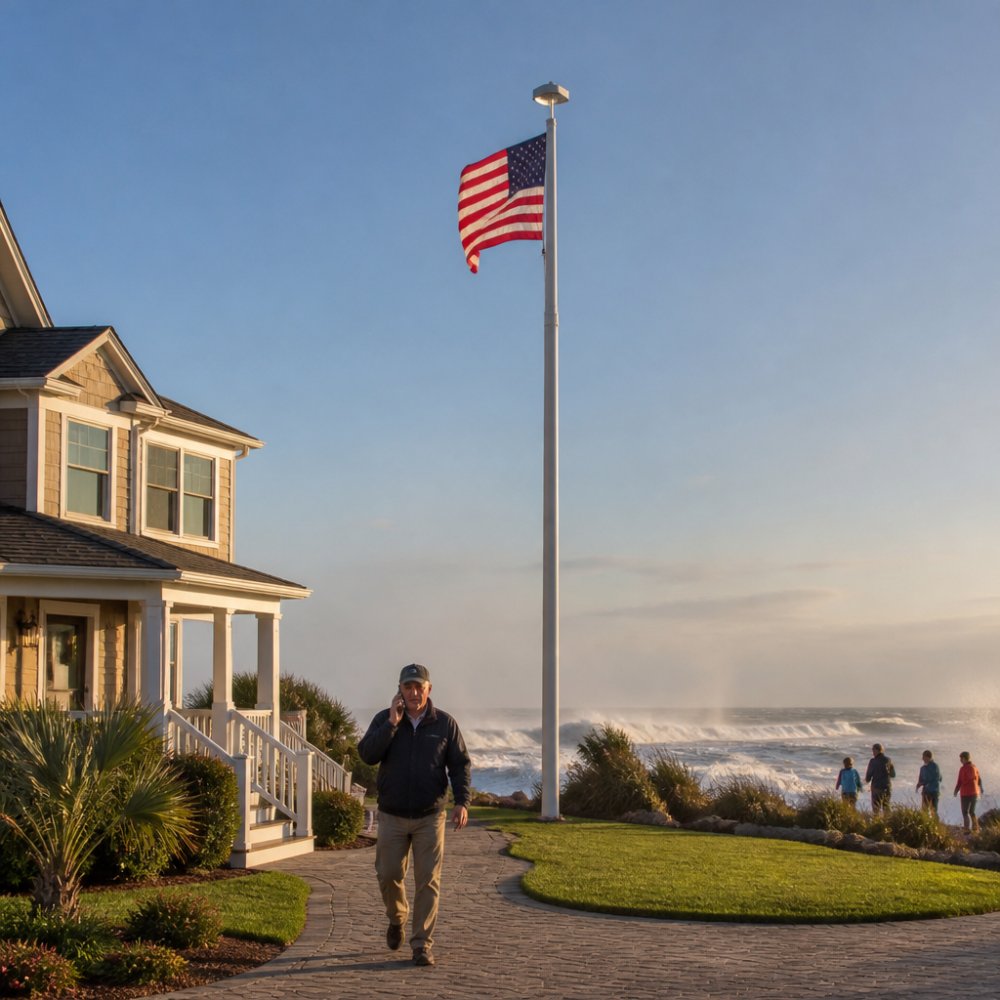
Coastal homeowners who invest in a durable flagpole for coastal homes with marine-grade materials and strong construction avoid the frustration of repeated replacements and maintenance failures.
Frequently Asked Questions
What makes a durable flagpole suitable for coastal homes with salt air?
A durable flagpole for coastal homes must use corrosion-resistant materials like 7000 T8 aluminum, which resists salt spray better than standard aluminum. The pole should feature stainless-steel hardware, a reinforced base (typically 3.5 inches in diameter), and a protective finish. Ten-gauge thickness provides strength to withstand coastal wind gusts and salt-air degradation. Regular inspection and cleaning remove salt residue that accelerates corrosion. A 15-year warranty signals manufacturer confidence in durability under marine-grade exposure.
How do you choose between fiberglass and aluminum for a coastal flagpole?
Aluminum, specifically 7000 T8 grade, outperforms fiberglass for coastal homes because it resists salt spray, requires minimal maintenance, and maintains strength in high winds. Fiberglass can degrade under intense UV exposure and salt-air conditions, leading to fiber separation and structural weakness. Aluminum's non-conductive properties also prevent galvanic corrosion when paired with stainless-steel hardware. While fiberglass may cost less initially, aluminum's longevity and low-maintenance requirements deliver better total cost of ownership for coastal properties.
What is the best flagpole material for coastal homes that resists rust and corrosion?
Seven-thousand T8 aluminum is the best flagpole material for coastal homes because it naturally resists oxidation and salt-spray corrosion far better than standard aluminum or steel. This aerospace-grade alloy contains specific trace elements that strengthen its corrosion resistance. Pair it with stainless-steel hardware (not galvanized steel) to prevent rust at attachment points. A galvanized-steel flash collar at the base protects the ground sleeve. This combination ensures your flagpole withstands salt air, humidity, and moisture for 15 years or more without rust-through or structural failure.
How often should a residential flagpole near the coast be inspected and maintained?
Inspect your residential flagpole monthly for salt residue buildup, loose hardware, or corrosion spots. Clean it every 2-3 months by rinsing with fresh water to remove salt spray and debris. Check the ball-bearing swivel system quarterly to ensure smooth rotation and apply light lubricant if movement becomes stiff. Examine the ground sleeve and base annually for water intrusion or settling. After storms or high-wind events, inspect the entire pole for stress fractures or bent sections. This proactive maintenance schedule extends your flagpole's life and catches problems before they become costly repairs.
What wind speed can a residential flagpole withstand in coastal conditions?
A heavy-duty residential flagpole with 10-gauge 7000 T8 aluminum and a 3.5-inch base can withstand sustained coastal winds and gusts typical of high-wind zones. The exact wind rating depends on pole height, flag size, and installation depth. Taller poles (25-30 feet) with larger flags require deeper foundations and may flex more under extreme gusts. Telescoping design allows you to lower the pole during severe weather or hurricane preparation, reducing wind load. Always follow manufacturer installation guidelines for your specific height and location to ensure safe performance during storms.
Should I choose a telescoping or fixed flagpole for my coastal home?
Telescoping flagpoles are ideal for coastal homes because they allow you to lower the mast for flag changes, maintenance, and storm preparation without external ladders or halyards. Lowering the pole reduces wind load during severe weather and makes cleaning easier. The five-section design of most residential models brings the flag attachment points within reach, so you can change flags safely. Fixed poles require external halyards and permanent height, making maintenance difficult and storm prep impossible. For coastal properties facing salt spray and frequent maintenance needs, telescoping design offers superior convenience and safety.