

Heavy Duty Aluminum for Outdoor Memorials
Table of Contents
- Why Heavy Duty Aluminum Is Best for Outdoor Memorials
- Aluminum vs. Bronze: Durability Comparison
- Understanding 7000 T8 Aluminum Strength Properties
- Corrosion Resistance and Weathering Performance
- Wind Load Ratings for Outdoor Structures
- Aluminum vs Fiberglass for Outdoor Durability
- Powder Coating vs. Anodizing for Long-Term Protection
- Mounting Hardware and Galvanic Corrosion Prevention
- Maintenance Schedules and Cost-Effectiveness
- Conclusion
- Frequently Asked Questions
Last Updated: September 21, 2026
Why Heavy Duty Aluminum Is Best for Outdoor Memorials
Heavy duty aluminum memorials offer unmatched durability and longevity for outdoor installations. Armor Flagpoles engineers flagpoles specifically to withstand harsh environmental conditions while maintaining structural integrity and aesthetic appeal. The choice between materials fundamentally shapes how well your memorial performs in wind, salt spray, temperature swings, and UV exposure.

Bronze corrodes visibly and requires regular polishing. Fiberglass degrades under UV light. Inferior aluminum alloys dent, oxidize, and fail structurally under load. Heavy duty aluminum, specifically 7000 T8 aluminum with proper thickness and finish, addresses these problems.
This guide covers the technical reasons why heavy duty aluminum memorials offer superior performance, how to evaluate structural specifications, and what finish systems protect your investment.
Aluminum vs. Bronze: Durability Comparison
Bronze develops a protective patina that masks active corrosion underneath, requiring annual polishing to maintain appearance. In coastal environments, bronze deteriorates rapidly and becomes brittle, with higher upfront costs and ongoing maintenance demands.
Aluminum forms a self-healing oxide layer that stops corrosion. Once sealed with powder coating or anodizing, heavy duty aluminum memorials maintain their finish and structural properties in salt spray, high winds, and extreme temperature swings.
Aluminum is lighter, easier to install, won't dent under wind load, and won't crack in freeze-thaw cycles. For outdoor memorials in harsh climates, this combination of strength, weather resistance, and low maintenance makes it the practical choice.
| Material | Maintenance Needs | Corrosion Risk | Structural Longevity | Cost |
|---|---|---|---|---|
| Bronze | Annual polishing | High in coastal areas | 20-30 years (with care) | Higher upfront |
| Fiberglass | Moderate (UV sealing) | Moderate (UV degradation) | 10-15 years | Moderate |
| Standard Aluminum | Minimal | Moderate (without finish) | 15-20 years | Lower |
| Heavy Duty 7000 T8 Aluminum | Minimal | Very low (with coating) | 15+ years | Moderate-high |
Understanding 7000 T8 Aluminum Strength Properties
7000 T8 aluminum is engineered for maximum tensile strength and fatigue resistance. The "7000" designation indicates zinc as the primary alloying element, which hardens the material. The "T8" heat treatment creates a crystalline structure that maximizes strength.
A 10-gauge 7000 T8 aluminum pole resists bending, denting, and warping under wind load, handling sustained gusts. Structural integrity remains consistent across temperature extremes.
7000 T8 aluminum achieves high tensile strength ratings while remaining significantly lighter, a critical strength-to-weight ratio for supporting wind loads without excessive base diameter or installation complexity.
The alloy composition enhances fatigue resistance, the ability to endure repeated wind stress cycles without developing micro-cracks at connection points or stress concentrations.
Corrosion Resistance and Weathering Performance
Aluminum's corrosion resistance comes from a naturally occurring oxide layer that forms instantly and is self-healing. Bronze continues corroding beneath its patina, while fiberglass's UV-sensitive resin gradually degrades.
In coastal areas and salt-road regions, salt accelerates corrosion by breaking down protective oxide layers. Aluminum's oxide layer resists salt attack far more effectively than bronze, protecting underlying metal even when deposits accumulate.
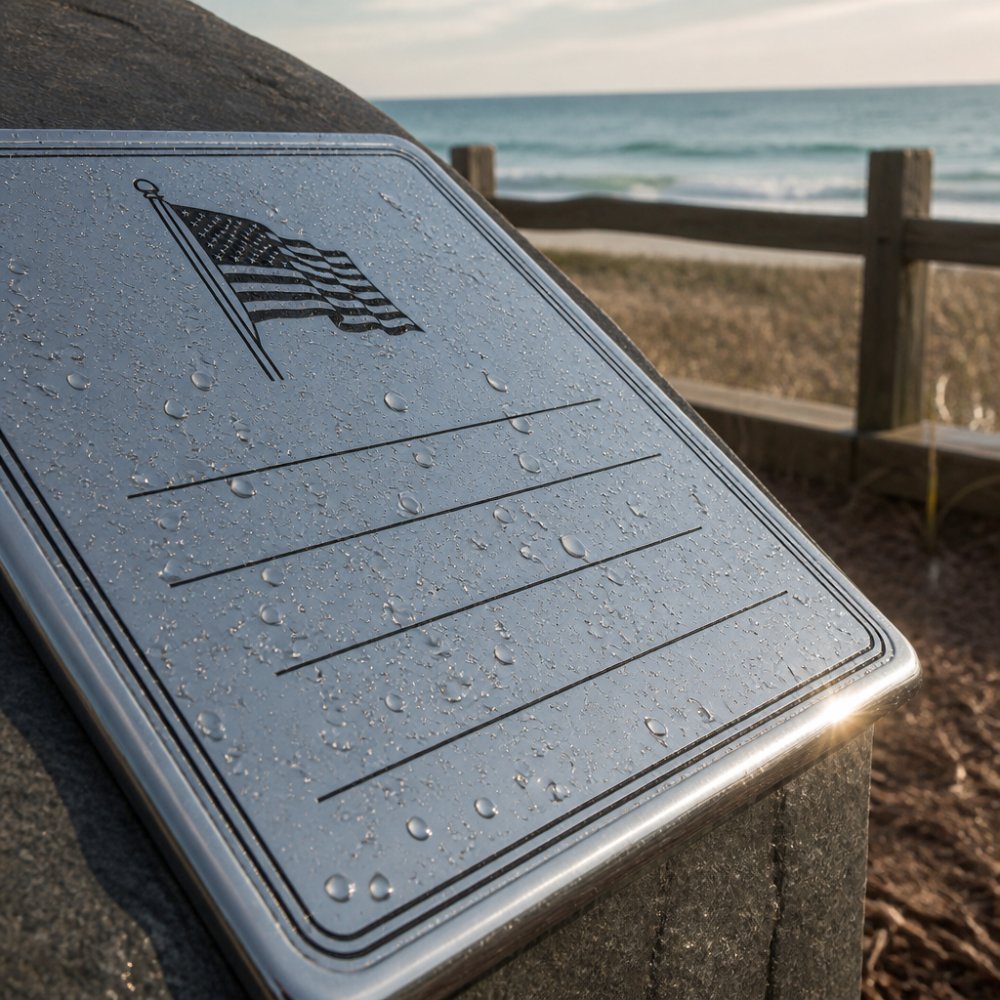
Fiberglass's polyester or epoxy resin breaks down under UV light, causing surface crazing and color fading. Aluminum itself is UV-stable, though painted or powder-coated finishes can fade if not properly formulated.
High-quality powder coating or anodized finish protects aluminum while maintaining appearance. Armor Flagpoles uses industrial-grade finishes that resist chalking, fading, and UV degradation.
Aluminum's flexibility allows it to expand and contract through freeze-thaw cycles without cracking, making it ideal for harsh winters.
Wind Load Ratings for Outdoor Structures
Wind load is the lateral force exerted on a vertical structure. Base diameter, wall thickness, and material strength determine how much wind load a memorial can safely withstand.
A 3½-inch base diameter with 10-gauge 7000 T8 aluminum provides structural rigidity for most installations. Wall thickness matters more than base diameter alone, 10-gauge (0.135-inch) thickness ensures bending resistance.
A well-engineered heavy duty aluminum memorial rated for 100+ mph winds survives severe conditions. Standard aluminum poles rated for only 50-75 mph may be less suitable in coastal or high-wind regions.

Connection points between pole and base affect wind load capacity. Stainless steel hardware and proper welding distribute stress evenly. Armor Flagpoles uses heavy-duty stainless steel hardware and galvanized steel flash collars to ensure the entire assembly handles extreme conditions.
Aluminum vs Fiberglass for Outdoor Durability
Fiberglass offers light weight and initial cost savings, but UV degradation is a consideration. After outdoor exposure, fiberglass can become brittle and lose structural integrity, especially in sunny climates.
Aluminum is UV-stable indefinitely. With proper protective finish, an aluminum memorial offers long-lasting durability, which can narrow the cost difference when replacement costs are factored in.
Fiberglass can absorb moisture, potentially causing internal degradation and delamination. Aluminum doesn't absorb moisture and resists delamination.
Fiberglass is lighter but less rigid. A fiberglass pole may bend more under wind load, potentially creating stress concentrations. Aluminum's stiffness means less deflection and lower stress on connections.
Fiberglass may require UV-protective coating reapplication. Aluminum with quality powder coating requires only occasional cleaning. Over time, fiberglass maintenance burden can exceed aluminum.
Powder Coating vs. Anodizing for Long-Term Protection
Powder coating and anodizing protect aluminum through different mechanisms and fail differently in harsh conditions. The wrong finish choice can result in visible degradation or premature replacement.
Anodizing creates a thicker oxide layer through electrochemical process, becoming part of the aluminum itself. The finish won't peel or chip because it is the material's surface, not a coating applied on top.
Anodizing's porous microscopic structure can allow chloride ions to penetrate in coastal environments, potentially causing white corrosion bloom on the surface. Water can penetrate in freeze-thaw cycles, potentially causing spalling. Anodizing may offer minimal UV protection; colored finishes can fade over time.
Powder coating creates a continuous, non-porous polymer film (2-3 mils thick) that acts as a complete physical barrier. Salt spray, moisture, and UV light cannot reach the underlying aluminum.
High-quality powder coatings contain UV absorbers and light stabilizers that prevent breakdown under prolonged sun exposure. Industrial-grade coatings maintain gloss and color retention, while anodized finishes may show color shift over time.
Powder coating's non-porous nature helps prevent water infiltration in freeze-thaw cycles, expanding and contracting without cracking. Anodizing's porosity can allow water penetration, potentially creating corrosion and spalling.
Salt spray resistance also favors powder coating. For memorials in coastal areas, this difference can contribute to a longer lifespan.
The trade-off is cost and repairability. Powder coating requires specialized application equipment and curing ovens, making it a more involved process than anodizing. However, if damage occurs, a scratch, dent, or chip, the damaged area can be touched up with touch-up paint or the entire piece can be re-coated. Anodizing, once applied, cannot be partially repaired; any damage exposes bare aluminum that may corrode unless sealed immediately.
25 Ft Heavy Duty Superior 2 Telescoping →
For heavy duty aluminum memorials in harsh outdoor environments, powder coating is a strong choice. It provides corrosion resistance in salt spray, protection against UV degradation, and resilience in freeze-thaw cycles. Anodizing works well for indoor or low-corrosion environments, but may not match powder coating's performance in the conditions outdoor memorials face.
Mounting Hardware and Galvanic Corrosion Prevention
Galvanic corrosion occurs when two different metals contact each other in the presence of moisture. Aluminum and steel, when connected without isolation, create an electrochemical cell that accelerates corrosion of the less noble metal (aluminum). This is a critical consideration for outdoor memorials where aluminum poles connect to steel bases or hardware.
The solution is simple: use stainless steel hardware exclusively, or isolate dissimilar metals with non-conductive materials. Stainless steel doesn't corrode significantly and won't trigger galvanic corrosion in aluminum. Galvanized steel, while corrosion-resistant, can still cause galvanic corrosion if in direct contact with aluminum.
Armor Flagpoles uses stainless steel flag clips, swivel rings, and fasteners specifically to prevent this problem. The flash collar, the component that seals the base where the pole enters the ground, is galvanized steel, but it's isolated from the aluminum pole by design, preventing direct contact.
The ground sleeve, which anchors the pole in concrete or soil, also requires attention. An aluminum ground sleeve prevents galvanic corrosion entirely. If steel is used, it must be properly galvanized and isolated from the aluminum pole with a non-conductive spacer or coating.
Installation technique matters as much as material selection. Fasteners should be stainless steel, not galvanized or plain steel. Sealants around connection points prevent water from accumulating and creating corrosive conditions. Proper grounding (electrical) also reduces galvanic potential in some installations.
Maintenance Schedules and Cost-Effectiveness
Heavy duty aluminum memorials require minimal maintenance compared to alternatives, but a structured maintenance schedule helps ensure the memorial performs optimally. Unlike bronze, which demands annual polishing, or fiberglass, which requires UV-protective coating reapplication every 5-7 years, aluminum with proper powder coating needs only periodic inspection and cleaning.
Year 1-3: Establishment Phase
During the first three years, the primary task is monitoring for installation issues and coating integrity. Inspect the memorial quarterly for loose fasteners, particularly after severe weather events. Check that stainless steel hardware remains tight and that the flash collar (the seal where the pole enters the ground) shows no gaps or water infiltration. Clean the memorial twice annually with mild soap and water to remove salt deposits, pollen, or dirt. In coastal areas, increase cleaning frequency to quarterly. This early attention catches minor issues before they become structural problems.
Year 4-10: Stable Performance Phase
Once the memorial has weathered through a full seasonal cycle, maintenance becomes truly minimal. Annual inspection is sufficient. Walk around the memorial and look for:
- Coating damage (scratches, chips, or areas where bare aluminum is exposed)
- Corrosion bloom (white powdery deposits, which indicate moisture has reached the aluminum)
- Fastener corrosion (discoloration or rust staining around bolts or clips)
- Base settlement or tilting (indicates ground movement or foundation issues)
Clean the memorial once annually, or twice annually in coastal areas. If minor coating damage is discovered (a scratch less than 1 inch), touch it up immediately with matching touch-up paint to prevent corrosion from spreading. Most manufacturers provide touch-up paint kits with the original memorial.
During this phase, the powder coating maintains its UV protection and color retention. Gloss may diminish slightly (a normal weathering process), but the protective barrier remains intact. No refinishing or resealing is required.
Year 11-15: Mid-Life Inspection Phase
At the 10-year mark, conduct a more thorough inspection. If the memorial is in a coastal or high-salt environment, have a professional inspect the coating for any signs of salt creep or corrosion. In most cases, the 3-mil powder coating will still be performing excellently. However, if the memorial was installed in an exceptionally harsh environment (directly on a salt-spray coast, for example), minor touch-ups may be needed.
Clean the memorial twice annually during this phase, particularly after winter if the region uses road salt. Salt deposits can accumulate in crevices and, if left unattended for years, can eventually penetrate the coating. Regular cleaning prevents this buildup.
Year 16-25: Long-Term Durability Phase
By year 16, the memorial has proven its durability. Most powder-coated aluminum memorials show minimal visible degradation at this stage. Gloss may be noticeably reduced compared to year 1, but the coating's protective function remains intact. Continue annual inspections and twice-annual cleaning in coastal areas.
If the memorial is in a mild climate and has been well-maintained, no refinishing is necessary. If it is in a harsh coastal environment and shows significant gloss loss or minor coating damage, consider a professional touch-up or full re-coating. A full re-coating at year 20-25 costs significantly less than replacing the memorial and extends the lifespan another 15+ years.
Cost-Effectiveness Over 25 Years
The total cost of ownership for a heavy duty aluminum memorial is substantially lower than alternatives when maintenance labor is factored in:
Bronze Memorial: Requires annual professional polishing (typically $150-300 per year), occasional structural repairs due to brittleness in freeze-thaw cycles, and potential replacement of corroded sections. Over 25 years: $3,750-7,500 in polishing alone, plus repair costs. Lifespan: 20-30 years with intensive care.
Fiberglass Memorial: Requires UV-protective coating reapplication every 5-7 years (typically $500-1,500 per application). Over 25 years: 3-4 re-coating cycles = $1,500-6,000. Structural degradation typically requires replacement by year 15-18. Total cost: $1,500-6,000 plus replacement cost.
Standard Aluminum Memorial: Requires touch-ups or full refinishing every 3-5 years due to inadequate initial finish (typically $300-800 per refinishing). Over 25 years: 5-8 refinishing cycles = $1,500-6,400. Structural integrity is adequate but not optimal. Lifespan: 15-20 years.
Heavy Duty 7000 T8 Aluminum Memorial: Requires annual inspection and cleaning (minimal labor cost, often owner-performed), occasional touch-up paint for minor damage (under $50 per application, 1-2 times over 25 years), and potentially one professional re-coating at year 20-25 if in a harsh environment (typically $800-1,500). Over 25 years: $50-2,350 in maintenance. Lifespan: 25+ years, often extends to 30+ with minimal care.
For property owners planning to stay in place long-term, the heavy duty aluminum choice offers a favorable total cost of ownership. The initial investment can be recovered over time through avoided maintenance and refinishing costs. For those in coastal or high-wind regions, the cost advantage can be significant.
Conclusion
Heavy duty aluminum memorials engineered from 7000 T8 alloy with 10-gauge thickness and industrial-grade powder coating deliver durability, minimal maintenance, and strong structural performance in harsh outdoor environments. The material resists corrosion, weathering, wind load, and UV degradation. Compared to bronze, fiberglass, or standard aluminum, heavy duty aluminum offers a strong balance of strength, longevity, and cost-effectiveness.
For homeowners, veterans, waterfront property owners, and businesses seeking a memorial that will endure decades of exposure without failure or significant maintenance, heavy duty aluminum is the engineered choice. Armor Flagpoles' 25 Ft Heavy Duty Superior 2 Telescoping Flagpole Kit combines 10-gauge 7000 T8 aluminum construction with a 3½-inch base, stainless steel hardware, and a 15-year factory warranty, delivering the structural integrity and weather resistance that outdoor memorials demand. Get started with Armor Flagpoles and install a memorial built to last.
Frequently Asked Questions
How is 7000 T8 aluminum different from standard aluminum for outdoor memorials?
7000 T8 aluminum is a high-strength alloy engineered for demanding applications. The 7000 series contains zinc, which increases tensile strength and structural integrity compared to standard aluminum. The T8 temper means it has been heat-treated and aged to maximum hardness. This combination makes it resistant to denting, warping, and stress cracking in harsh outdoor conditions. Heavy duty aluminum poles using 7000 T8 maintain their shape and finish for decades with minimal degradation.
Will a heavy duty aluminum memorial plaque rust in coastal or high-wind areas?
No. Heavy duty aluminum does not rust because it lacks iron, which causes rust. Instead, aluminum oxidizes, forming a thin protective oxide layer that prevents further corrosion. In coastal salt spray or high-wind environments, this oxide layer is especially valuable. With proper finish protection like powder coating or anodizing, aluminum memorials resist corrosion. Bronze develops patina and may require regular maintenance to prevent green oxidation and structural weakening.
What maintenance does a heavy duty aluminum outdoor memorial actually require?
Heavy duty aluminum memorials require minimal maintenance. An annual rinse with fresh water removes salt spray and dust buildup, preserving the finish. If powder-coated or anodized, no additional treatment is typically needed. Aluminum's natural corrosion resistance and protective coatings contribute to a low maintenance burden. A 15-year warranty on heavy duty aluminum poles reflects their durability.
Can heavy duty aluminum withstand high wind loads for outdoor memorial installations?
Yes. Heavy duty aluminum poles engineered with 10-gauge thickness and 7000 T8 alloy can handle significant wind load ratings for outdoor structures. The combination of high tensile strength, proper base diameter (typically 3.5 inches), and five-section telescoping design distributes wind forces effectively. Stainless-steel hardware prevents galvanic corrosion at connection points. In high-wind environments, heavy duty aluminum maintains structural integrity better than lighter materials, and the telescoping design allows you to lower the pole during severe weather to protect the installation.