

Why Flagpole Sections Get Stuck: Fix a Telescoping Pole
Table of Contents
- Why Do Flagpole Sections Get Stuck?
- Dirt, Grit, and Debris at the Joints
- Corrosion and Tight Tolerances
- Worn Springs and Locking Mechanisms
- How to Unstick a Telescoping Flagpole
- How to Clean a Telescoping Flagpole
- When Telescoping Flagpole Sections Won't Lock
- Telescoping Flagpole Maintenance That Prevents Jams
- When to Stop and Replace a Section
- Conclusion
- Frequently Asked Questions
Last Updated: October 22, 2026
Why Do Flagpole Sections Get Stuck?
Flagpole sections stuck in place usually trace back to grit, corrosion, or a worn locking button creating friction between the telescoping tubes. The inner section binds against the outer one and won't slide. At Armor Flagpoles, we hear this question most from owners of older poles. The good news: most jams have a simple cause and a simple fix.
Below, we'll show you how to find the cause and free the section without damaging the pole.
Here's what most guides get wrong. They tell you to pull harder. Force is how poles get bent, and a bent section never slides right again.
Dirt, Grit, and Debris at the Joints
Dirt buildup is the most common reason you find flagpole sections stuck. Sand, pollen, grass clippings, and road dust collect in the gap between sections. Each raise and lower grinds that grit into the joint.
Coastal properties make it worse. Salt spray dries into a sticky film that traps sand in the collar area. A pole near a gravel driveway or a beach path picks up debris fast.
Watch for these signs:
- The section moves a little, then stops hard
- You hear a gritty scraping sound
- Dark lines show at the joint where the sections meet
If the section shifts slightly, debris is usually the culprit. A full stop with no movement points elsewhere.
Corrosion and Tight Tolerances
Aluminum does not rust like steel, but it does corrode. Salt air and standing water pit the surface and leave a chalky white film. That film adds thickness, and telescoping poles run on tight tolerances.
A few thousandths of an inch matters here. Once corrosion builds on the inner tube, the fit tightens and the section binds. Poles stored wet or left extended for months are the usual victims.
Check the joint for white powder or dark pitting. Corrosion near the flare point means the section needs cleaning before it can move.
Worn Springs and Locking Mechanisms
A worn spring or locking button can jam a pole in two ways. The button may stick out and catch on the outer tube. Or it may fail to retract, so the section won't release at all.
Test it simply. Press the locking button with your thumb. It should spring back cleanly. A mushy or slow button means the spring is tired or packed with grit.
Inspect the locking ring and sleeve too. Cracks or rounded edges let the section shift off-center, which causes binding.
How to Unstick a Telescoping Flagpole
Start with diagnosis, not force. Most stuck sections release with cleaning and patience. The steps below work on any telescoping pole, including our 16 Ft Classic and 20 Ft Superior 1. The key is to identify which kind of stuck you have before you touch the pole.

Step 1: Identify the Type of Stuck Section
"Stuck" means different things depending on the hardware. Work through this short decision flow before you try to move anything.
| What You See | What It Usually Means | First Move |
|---|---|---|
| A telescoping section wiggles but won't slide | Dirt or grit at the joint | Clean and work the joint |
| A telescoping section won't move at all | Corrosion, misalignment, or a bent tube | Inspect for pitting and bends |
| The locking button won't press | Worn spring or packed debris | Free the button, check the spring |
| The section drops but won't lock | Worn locking mechanism | Inspect the button and ring |
| The whole pole won't lift out of its ground sleeve | Grit, corrosion, or a bound base | Treat it as a base problem, not a section problem |
| The pole is stuck at the hitch mount | Bound base or overtightened hardware | Loosen the adjustment screw and stop bolt |
That table tells you which repair to try first. Guessing wastes time and risks damage.
Step 2: Release a Stuck Telescoping Section Safely
Once you know the cause, release the section with control.
- Clean the joint first. Wipe the exposed tube with a damp cloth.
- Grip the section close to the joint, not at the far end.
- Twist gently while pulling straight down.
- Tap the collar lightly with your palm to break grit loose.
- Work in small moves. Ten small pulls beat one hard yank.
A strap wrench gives better grip on slick aluminum. Pad the jaws so you don't scratch the finish. On aluminum poles, a bent tube never slides right again, so stop the moment you feel resistance spike.
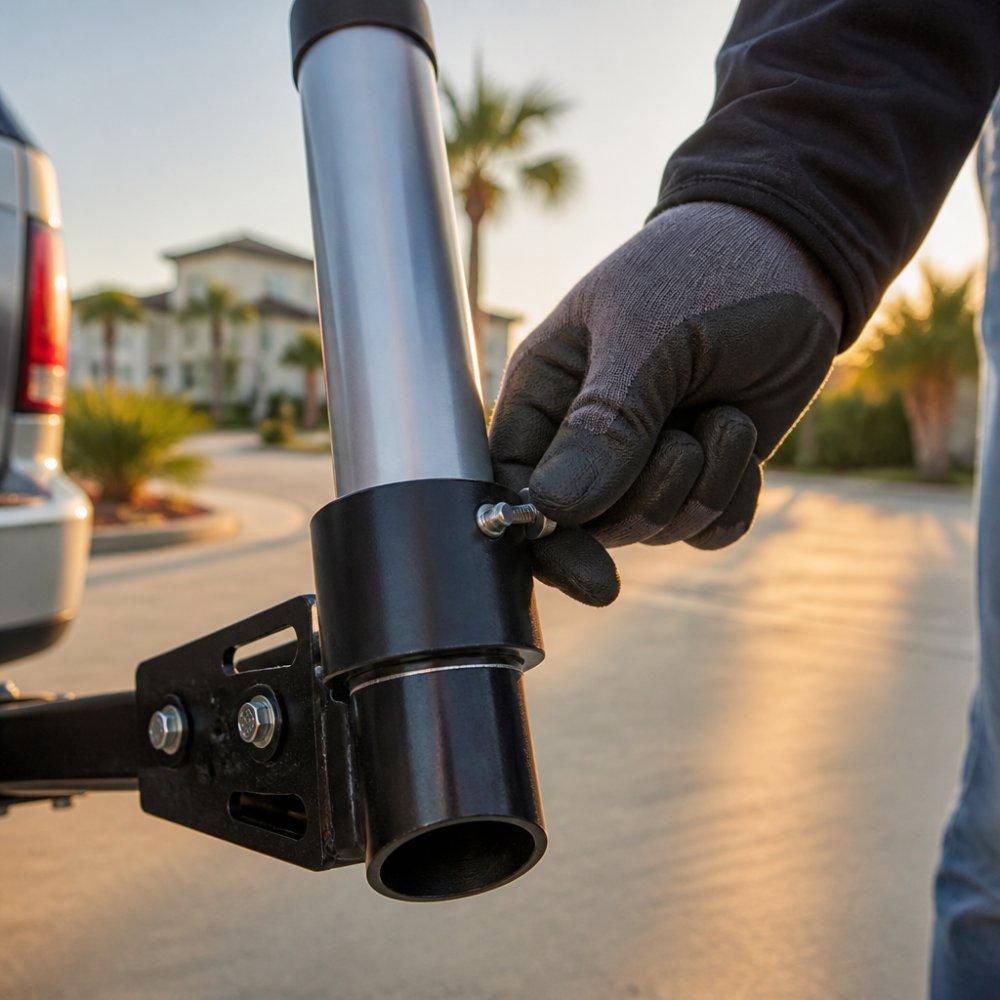
Step 3: Free a Pole Stuck in a Ground Sleeve or Hitch Mount
A pole that won't lift out of its sleeve is a different problem. The base is bound, not the telescoping sections.
- Rinse the gap between the pole base and the sleeve with fresh water.
- Work the pole in small side-to-side motions to break the grit bond.
- Check the adjustment screw and bottom stop bolt on the mount. Back them off a quarter turn.
- Confirm the base diameter matches the mount: 2.4 inches for the 16 Ft Classic and 2.75 inches for the 20 Ft Superior 1.
Our ground sleeves have an open bottom for drainage, which helps water escape and reduces corrosion at the base. If the pole still won't release after cleaning and loosening, stop and inspect for a bent base before you pull harder.
How to Clean a Telescoping Flagpole
Cleaning is the real fix for most stuck sections. But before you wipe anything down, know what you're looking at. Dirt, corrosion, and mechanical binding each leave different clues, and each needs a different response.
Tell Dirt, Corrosion, and Binding Apart
| What You Find | What It Means | What to Do |
|---|---|---|
| Gritty scraping sound, dark lines at the joint | Dirt or debris | Clean and work the joint |
| Chalky white film or dark pitting | Corrosion | Clean thoroughly, then inspect for pitting |
| Section sits cocked or off-center | Misalignment or binding | Check the collar and locking ring |
| Button presses but section still binds | Mechanical failure | Inspect the spring and button hole |
If the section shifts slightly, debris is usually the culprit. A full stop with no movement points elsewhere. Corrosion near the flare point means the section needs cleaning before it can move.
Clean Each Section the Right Way
Lower the pole fully and wipe each section with a damp cloth and mild soap. Rinse with clean water and dry before you raise it again.
20 Ft Superior 1 Telescoping Flagpole Kit →
Pay attention to these spots:
- The collar where each section meets the next
- The locking button holes
- The flare point on each tube
- The base and ground sleeve area
A soft bottle brush reaches inside the collar. Never use abrasive pads or sandpaper on the aluminum. They scratch the surface and give corrosion a place to start.
Clean the flag hardware too. Salt and grit collect on the clips and retainer rings. Wipe them down and check for fraying on the flag's edges.
Know When to Stop Cleaning and Replace
Some damage is beyond cleaning. Stop and replace the section if you find:
- Deep pitting or cracks in the aluminum
- A tube that stays bent after you release pressure
- A locking button hole that is oval or wallowed out
- A section that binds even after a full clean and dry
A bent or cracked section can fail under wind load. That is a safety issue, not a maintenance one. Replace it. If the damage is minor, a replacement part may be all you need. Our team can help you match the right component to your pole model.
When Telescoping Flagpole Sections Won't Lock
Sections that won't lock usually have a button or spring problem. The locking button must pop fully through the hole in the outer tube. If it only half-engages, the section will drop.
Check three things:
- Press the button. Does it spring back with a firm click?
- Look into the hole. Is it packed with dirt?
- Wiggle the section. Does it sit flush, or is it cocked?
A button packed with grit will not seat. Clean the hole with a toothpick or a thin wire. If the spring is weak, the locking mechanism needs a replacement part.
On our poles, the hardware is built to last, and replacement parts are available. A quick call or email gets you the right component.
Telescoping Flagpole Maintenance That Prevents Jams
A simple maintenance routine keeps sections sliding freely. Lower and clean the pole twice a year. Add a check after any big storm.
Your routine should cover:
- Wipe each section with a damp cloth
- Rinse the collars and button holes
- Dry the pole before raising it
- Check the flag clips and retainer rings
- Look for corrosion at every joint
- Test each locking button
Store the pole lowered if you expect long stretches of bad weather. A lowered pole keeps grit out of the joints and takes stress off the sections.
Seasonal Checks for Coastal and High-Wind Properties
Coastal and windy properties need more frequent checks. Salt air and blowing sand work into joints fast. Clean and inspect quarterly instead of twice a year.
After a storm, lower the pole and rinse it with fresh water. Check the ground sleeve for standing water. Our ground sleeves have an open bottom for drainage, which helps water escape.
If your pole sits on an RV, check the mount before every trip. Confirm the base diameter fits your hitch mount: 2.4 inches for the 16 Ft Classic and 2.75 inches for the 20 Ft Superior 1.

When to Stop and Replace a Section
Some damage is beyond cleaning. Stop and replace the section if you find:
- Deep pitting or cracks in the aluminum
- A tube that stays bent after you release pressure
- A locking button hole that is oval or wallowed out
- A section that binds even after a full clean and dry
A bent or cracked section can fail under wind load. That is a safety issue, not a maintenance one. Replace it.
If the damage is minor, a replacement part may be all you need. Our team can help you match the right component to your pole model.
Conclusion
Stuck sections almost always come down to grit, corrosion, or a worn locking part. Clean the joints, check the buttons, and skip the lubricants. Our telescoping flagpoles use 7000-T8 aluminum with 10-gauge walls. Every kit ships with a matched flag, solar light, and hardware. This takes the guesswork out of setup. If a section ever gives you trouble, our team can help you find the right part. Browse our telescoping flagpole kits and pick the size that fits your property.
Frequently Asked Questions
Why are my telescoping flagpole sections stuck?
The most common cause is dirt and grit packed into the joints and locking-button holes. Corrosion, a bent section, or a worn spring can also bind a pole. Before forcing anything, check whether the section is dirty, corroded, or physically damaged. Each cause needs a different fix, and forcing a jammed section can make it worse.
Can dirt or corrosion make flagpole sections stick?
Yes. Grit around the locking ring and button holes acts like sandpaper and wedges sections tight. On coastal properties, salt spray speeds corrosion inside the joints. Rinse and dry the pole after exposure to salt air, and inspect the joints each season. Clean sections slide and lock far more reliably than neglected ones.
Should I force a stuck flagpole section to move?
No. Forcing a jammed section can bend the aluminum tube, crack a locking ring, or snap a spring. Try a gentle twist and steady pull first. If it will not budge, stop and inspect the joint for debris or damage. A bent or cracked section should be replaced rather than forced.
How often should you maintain a telescoping flagpole?
Inspect the pole at least twice a year, and more often in coastal or high-wind areas. Clean the joints, check the locking buttons and springs, and look for fraying on the flag and clips. A quick seasonal check keeps sections sliding smoothly and catches small problems before they become stuck sections.