

How to Handle Flagpole Replacement Parts and Service
Last Updated: October 28, 2026
Quick Summary
A flagpole replacement is usually a parts job, not a whole-pole job. Lower the pole, inspect the locking collars, halyard, swivel, finial, and base, then match your pole model and base diameter to the right part. Swap user-serviceable parts yourself and replace the pole only when a section, base, or ground sleeve is structurally compromised.
- Measure your base diameter first: the 16 Ft Classic is 2.4 inches and the 20 Ft Superior 1 is 2.75 inches.
- You can swap clips, halyard, swivels, cleats, finials, and locking collars without special tools.
- Bent or cracked aluminum sections and cracked bases mean replacement, not repair.
- Inspect your flagpole every 3 to 6 months to catch failures early.
- Hire a pro for commercial-height poles, cracked bases, or sections seized beyond hand force.
Table of Contents
- Start With a Diagnosis, Not a Shopping Cart
- The Four Failure Points on a Telescoping Pole
- Telescoping Flagpole Replacement Parts: What You Can Actually Swap
- Flagpole Locking Mechanism Repair: Why Sections Slip or Stick
- Halyards, Swivels, Finials, and Mounting Hardware
- Your Flagpole Maintenance Checklist for Every Season
- When to Call a Flagpole Repair Service
- Repair or Replace? A Decision Framework
- Order the Right Part From Armor Flagpoles
- Frequently Asked Questions
Start With a Diagnosis, Not a Shopping Cart
The rope snapped, a section won't lock, or the pole leans after a storm. Here's the good news: a flagpole replacement is usually a parts job, not a whole-pole job.
At Armor Flagpoles, we sell telescoping poles. We'd rather you diagnose the actual failure first.
The Four Failure Points on a Telescoping Pole
Telescoping pole problems can involve several areas.
- The locking mechanism. Collars and twist-locks hold each section at height.
- The halyard. The rope or cable that raises and lowers the flag.
- The swivel and finial. The top hardware that lets the flag spin freely.
- The base and ground sleeve. The foundation that keeps the pole vertical.
Lower the pole and inspect it before ordering anything. For a deeper look at how the locking system works, read our guide to flagpole locking mechanisms.
Telescoping Flagpole Replacement Parts: What You Can Actually Swap
Most telescoping flagpole replacement parts are user-serviceable. You can swap clips, halyard, swivels, cleats, finials, and locking collars without special tools. Complete repair kits exist too, and retailers list clips, halyard rope, cleats, pulleys, truck assemblies, brackets, sleeves, and pins as individual parts or kit contents, according to Flagpole Hardware, Parts & Accessories.
Identify the Pole Before You Identify the Part
Before you shop, write down four facts about your pole.
- Pole model and height. Our 16 Ft Classic and 20 Ft Superior 1 use different base diameters.
- Base diameter. Measure across the bottom of the pole. The 16 Ft Classic base measures 2.4 inches. The 20 Ft Superior 1 measures 2.75 inches.
Measure twice, then match the number to the listing.
A Simple Measurement Workflow
Work from the bottom up.
Keep those notes with your pole's paperwork.
Parts You Can Swap Yourself
- Flag clips and rings. Replace worn clips when they stop holding the grommets securely.
- Halyard rope or cable. Re-roping is a routine job when the line frays or binds.
- Swivels. A stiff swivel whips the flag and frays grommets, so replace it early.
- Cleats and pulleys. Swap these when they crack, seize, or chew the halyard.
- Finials. A loose or missing finial lets water into the pole.
- Locking collars. Replace cracked or stripped collars rather than forcing a stuck section.
Parts That Usually Mean a New Pole
- Bent or cracked aluminum sections. These can't be safely restored.
- A base that is cracked or shifting. Structural failure is a replacement signal.
- Seized sections beyond hand force. Forcing them can bend the aluminum.
Flagpole Locking Mechanism Repair: Why Sections Slip or Stick
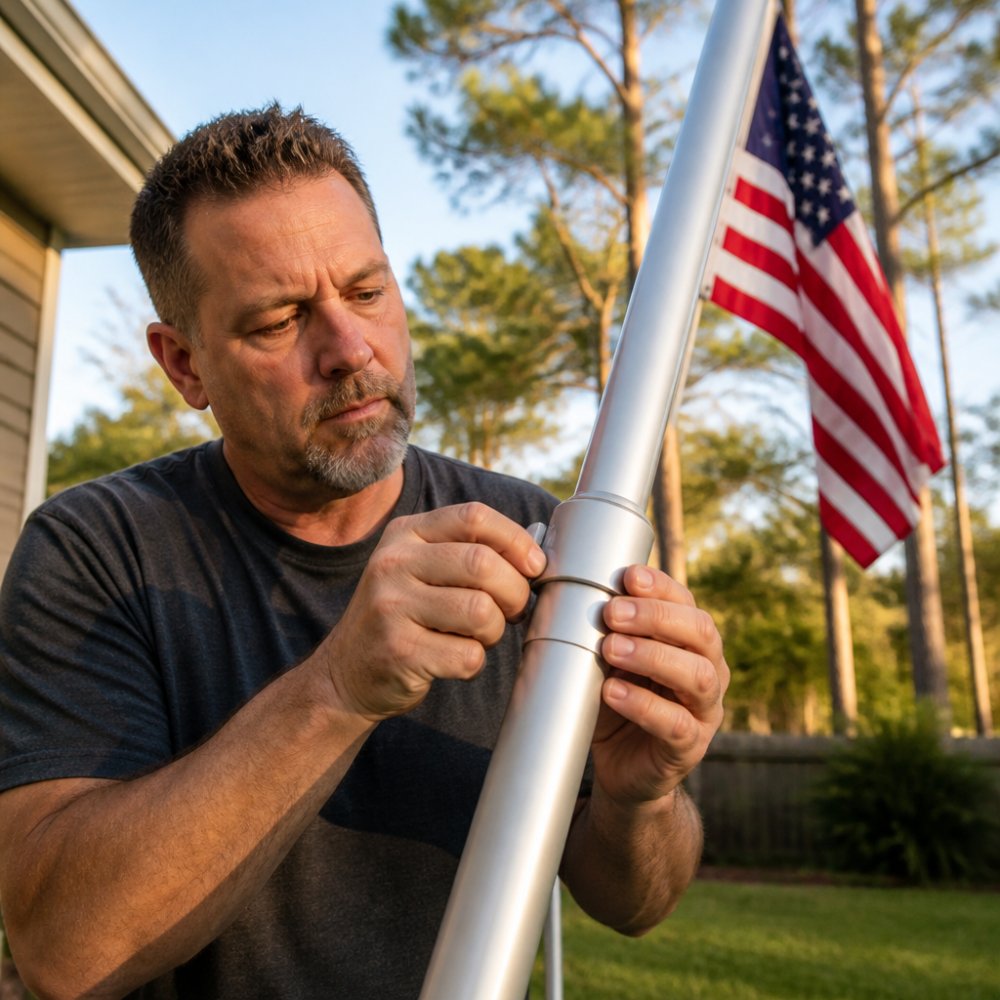
Watch out: forcing a stuck section can bend the aluminum. That turns a cheap fix into a new pole. Our step-by-step walkthrough on fixing a stuck telescoping pole covers the safe method.
Halyards, Swivels, Finials, and Mounting Hardware
Mounting hardware includes brackets, flag holders, and ground sleeves. On an RV, check hitch-mount compatibility against your pole's base diameter.
20 Ft Superior 1 Telescoping Flagpole Kit →
Lower campers typically use the 16-foot pole. Taller RVs and fifth wheels need the 20-foot Superior 1 for flag clearance. Always check actual roof clearance before you mount.
Your Flagpole Maintenance Checklist for Every Season
A short inspection twice a year prevents most failures. For a full walkthrough, read our telescoping flagpole maintenance guide. Flagpole Farm's replacement parts guide recommends inspecting flagpoles every 3 to 6 months.
- Lower the pole and inspect every section for bends
- Check the halyard for fraying and replace if worn
- Test the swivel for free rotation
- Clean and lubricate the locking collars
- Tighten the finial and all mounting hardware
- Flush the base and confirm drainage
- Check the ground sleeve for leaning or loose soil
When to Call a Flagpole Repair Service
Hire help when:
- The pole is commercial height or permanently fixed
- The base or ground sleeve is cracked or shifting
- The pole leans and won't realign
- Sections are seized beyond hand force
Repair or Replace? A Decision Framework
Repair wins when the pole is structurally sound and one component failed. Replace when the pole itself is compromised. The hard part is the middle ground: an older pole with two or three small failures at once.
Start With Three Questions
- Is the pole structure sound? Check for bends, cracks, and a stable base.
- How many parts failed? One worn part is a repair. Several stacked failures on an old pole often point to replacement.
- Can you do the work safely? Height, heavy sections, and structural damage are pro territory.
Repair Signals
- A frayed halyard or worn clips
- A stuck or slipping collar that cleaning or a new collar fixes
- A seized swivel or loose finial
- A single worn part on an otherwise sound pole
Replace Signals
- A bent or cracked section
- A cracked base or shifting ground sleeve
- A leaning pole that won't realign
- Multiple failures stacking up on an old pole
Action Flag compares maintenance with replacement and gives a replacement range of $250 to over $1,000, varying with height and material (Action Flag's maintenance vs replacement guide). Use that range as context, not a quote.
Safety First: When to Hire a Professional
Some jobs belong to trained technicians. Hire help when:
- The pole is commercial height or permanently fixed
- The base or ground sleeve is cracked or shifting
- The pole leans and won't realign
- Sections are seized beyond hand force
- The work requires a ladder at height or pole lowering you can't control
A Quick Gut-Check Table
| Situation | Action | Why |
|---|---|---|
| Frayed halyard or worn clips | Repair | Low-cost, user-serviceable |
| Stuck or slipping collar | Repair | Cleaning or a new collar fixes it |
| Seized swivel or loose finial | Repair | Simple top hardware swap |
| Bent or cracked section | Replace | Section can't be safely restored |
| Cracked base or shifting sleeve | Replace | Structural failure |
| Leaning pole that won't realign | Hire a pro | Safety risk at height |
Order the Right Part From Armor Flagpoles
We select the included flag, solar light, and flag hardware to match each specific pole, reducing the work of finding compatible components. Our 7000 T8 aluminum poles carry a 15-year factory warranty.
Visit our shop to find your replacement part.
Frequently Asked Questions
What parts of a flagpole can be replaced?
On a telescoping pole, the swappable parts are the locking collars and pins, the top swivel, the flag clips, the finial, the ground sleeve, and the mounting hardware. On a sectional or commercial pole, you can also replace the halyard, the pulley, the cleat, and the truck assembly. A retailer lists a complete heavy-duty telescoping replacement pole at $361.20, which shows how much a full swap costs compared with a single part. Check your model's parts list before ordering.
How do I identify the right telescoping flagpole replacement parts for my pole?
Armor Flagpoles poles use a 2.4-inch base on the 16 Ft Classic and a 2.75-inch base on the 20 Ft Superior 1.
Why won't my telescoping flagpole sections stay extended?
A section that slips usually has a worn or dirty locking collar, a bent pin, or grit trapped in the joint. Lower the pole, clean the joint, and inspect the locking mechanism for cracks or missing pieces. If the collar is cracked, replace it rather than tightening it further. A section that sticks on the way up often has a burr or corrosion inside the joint. Flagpole Farm recommends inspecting flagpoles every 3 to 6 months, which catches most of these issues early.
When should I contact a flagpole repair service?
Call a professional when the pole is leaning, the base is loose in the ground, a section is bent, or the work requires climbing. A leaning flagpole can indicate a footing problem that a part swap will not fix. Mister Flagpole reported repairing a 100-foot steel pole by replacing the truck, cable, and hardware, but that job needed equipment most homeowners do not own. For a telescoping pole under 20 feet, most hardware swaps are a safe DIY job.
A broken flagpole part doesn't have to end your flag display. Diagnose the failure, match the part to your pole, and repair what's serviceable. When you need a part that fits the first time, Armor Flagpoles matches hardware to your exact model. Get started with Armor Flagpoles and keep your colors flying.
